The ENERGETIC AGNOSTIC
Presentation to The Agnostics Group, Existentialist Society, Melbourne, Australia
Thor May PhD, 13 June 2026
The Energetic Agnostic - Thor May
1. Introduction
For some puzzling reason David Miller has asked me back to this forum for a third time. Each time I feel a severe onset of imposter syndrome, and today is no different. I have some anthropological interest in religions, but perhaps unlike many of you I am not widely read in the field, and am certainly not a scholar of it. All I can offer is some personal reflection on the potentials and outcomes of having an agnostic mindset.
What happens if we try to keep our thinking and actions free of bias, not just passively, but actively seek open outcomes regardless of pressure? Is a claim of being completely open minded even credible? What forces attempt to deflect our impartiality as we bump up against situations where individuals and groups have a strong attachment to some guiding set of beliefs, or some financial or other interest in particular outcomes. I am not here to attack these attachments. They clearly serve a purpose, even if it is not my purpose. The contradictions are not going to go away. Since childhood we have met this kind of dilemma. Probably no child over seven or eight still believes in Santa Chaus, but we still keep him on the payroll, and he still serves a purpose. Also most kids are smart enough to lie about Santa Clause if you happen to ask them. So, perhaps, it is like this with religions too.
Now to our topic of The Energetic Agnostic ….
Let me begin with an anecdote. A few decades ago I had an appointment with famous specialist in Royal Melbourne Hospital. He led a cardiac research team. As I entered the great man's clinic he looked me up and down, then said “Strip down to your panties and bra. I will be with you in a minute.” Well, cross-dressing is not my thing. I'm definitely an ugly version of the male of the species. When he returned a few minutes later I smiled and asked whether I could interview him. As a part of PhD research then I was studying formulaic language, its uses and effects on thinking. Thinking in fixed patterns, including in language, is something we all do. Life would be impossible without these predictable, off the shelf habits. Life would be impossible if we had to think through each phrase and action step by step. Our memory couldn't handle it, and it is not the way our brains work. But being human and a bit lazy we also often overdo this attachment to familiar phrases, familiar ideas, and familiar routines. Some people are more rigid about that than others. Look at politics. In this doctor's case, he was a research leader and therefore, supposedly, alert to situations where familiar answers did not meet the problem at hand. His job was to be AGNOSTIC about known solutions and willing to test whether they really worked.
As it happened, I had not politely ignored his accidental misuse of doctor to patient formula language, and his failure to even register my gender. Instead I had reversed our roles, and challenged him in the interest of science, to reflect on the language trap he had fallen into. His actual response was explosive. The loss of dignity, in his mind, overrode any niceties about scientific enquiry. He lost his temper, said roughly that I really should not be seeing him, and immediately sent me to another doctor.
Our
topic today is The Energetic Agnostic. The medical anecdote just
recounted tells us a lot about how hard it is to be truly agnostic in
pursuing honest enqiry. Having an open mind is rarely a passive, easy
going option. There is really a great more to say about medical
practice and research because it is one area where the problem is
widespread, the stakes are high, and we all have some experience of
the outcomes. Here today I can only touch upon it.
2. WHAT KIND OF AGNOSTIC AM I, ARE YOU?
Month after month in this Agnostics branch of the Existentialist Society you must hear a wide variety of suggestions about the nature of agnosticism. Later perhaps you can throw some of those back at me. My own perspective is that that of the eternal outsider, forever separated from any tribal attachment to what is socially proper to believe or express. Born in 1945 into a socially marginal working class Sydney household, my father was an itinerant carpenter and the family rarely had visitors. As an adult, I have stumbled with low expectations through over 40 jobs in seven countries, from dockyard labourer to, eventually, university lecturer, Perhaps shaped by what I had seen of home life, I avoided the package of marriage, a mortgage, and a conventional dull career. In the 1980s, then 1990s, I walked away from two doctoral dissertations on theoretical linguistics, concluding that the models in play could not work in principle, and that the model based evidence was often more theological than scientific. In 2010 I did actually finish a PhD on barriers to teaching productivity – twenty case studies from places I knew in seven countries, where student & teacher productivity had been affected by the habits, beliefs and processes of other players in the institutional hierarchy. That is not irrelevant to today’s topic. In short, I myself have never found a home. Tribal commitment is the norm almost everywhere.
My kind of social and political agnosticism born of never belonging is not for everyone. If the point of energetic agnosticism is ultimately to maximize a group's chance of survival, my fairly extreme separation from a tribal identity is probably not ideal. The optimum effect on others by an influencer might be somewhere else along the scale of identifying with a group. Of course, is far easier for typical folk to just go with the flow.
3. The Game is Rigged – Human Meddling with Diversity, Nature’s Survival Tool
It is not original to notice that we all live inside bubbles, boxes, fantasies, dreams .. or wherever you want to put a boundary. These boundaries can be purely personal, shared in a social conspiracy or embedded with all the formal barriers of a nation state. Even the flakiest individuals can be remarkably creative about inventing their versions of logical argument within such boundaries. Maybe it has to be like that. Systems with known boundaries are effective at keeping people’s lives together and on track so long as those boundaries are stable.
Within the stable boundaries of human social systems accepted by large groups of people, babies are born, wars are fought, and managers invent KPIs to optimize what they consider to be self evident truths. Doctors make diagnoses on what they think accounts for their mental models of human bodies, Jesuits create clever arguments to prove that god exists according to the boundaries of their religion, and researchers explore hypotheses to prove that variables they examine act like the correct widgets in their model of an automatic gearbox or the moon’s gravity.
So what happens when these bubbles, boxes and imagined worlds fall apart? The evolutionary patterns of nature on earth give us the clearest first answer to that question. The answer is extinction unless there is diversity. When the environment changes drastically whole species of plants and animals will be wiped out. We hear the expression “survival of the fittest”. However it will probably not be that individual tree or individual hominid who was fittest in the old environment who survives. It will be some individual or collection of individuals who have a had weird mutation, perhaps previously useless but which is now critical for survival. The greater the diversity among the individuals in a species, the greater the likelihood that mutation will let some of them survive drastic environmental change.
Well humans have gone rogue and partly taken charge of their own evolution, including rather clumsily organizing themselves into cultures and economies. At first these cultures and economies showed remarkably stable general patterns over thousands of years, regardless of warfare, disease and, yes, the extinction of sub groups. In the last three centuries however, we have gone into an ever faster spiral of change. That has had a cost. The old rule of unplanned diversity in nature as a guarantor of survival has been modified in a somewhat unexpected way by our choices. Human societies can deliberately allow their populations to tend towards diversity, or force them towards conformity, and this ultimately affects whether they thrive. You see this at its most extreme form in warfare when out of desperation, rigid practices might be put aside, and experiments proliferate regardless of hierarchy. Innovation peaks. For example, think of Ukraine Vs Russia in their current conflict.
When the world changes, when our bubbles and mental boxes and laws no longer fit a new reality, those who survive are those who can step beyond existing norms and existing beliefs about what is supposedly “true” and acceptable. The new paths for survival usually do not emerge magically. Time and again we see that a path forward has been anticipated and shaped by a few individuals who had looked critically at the old world around them and dared to ask “What if ?“. These were actors with a more or less AGNOSTIC mindset, curious about what seemed like eternal truths to all the others, and prepared to explore different possibilities with an open mind. Often they had been vilified or ostracized or simply seen as failures in the old world. Since the Agnostics Group being addressed in this talk has a deep interest in religion, many of you will know that the history of religions themselves closely mirror this pattern of collapsing orthodoxy being saved by supposedly heretical thinkers. In normal times though, human societies are routinely adapted to average people doing average things. It has to be that way. However, playing god, as we are here, with an eye across the span of generations, the takeaway is that it is the agnostic mind of the curious outsider, or the troubled mind of a thoughtful insider who sees boundaries failing, which saves the crowd when things suddenly no longer work.
4. Black Cat or White Cat? Is only One Kind of Mouse OK to Catch?
Jesuits / Communists / Putinists / Political Parties / Research Projects / Everyone
Once humans started to think about their place in the great cavalcade of nature, they invented religions to provide a rationale for the whole mystery. They also acutely noticed that there was a BALANCE OF FORCES, within their own bodies, within their communities, and within the seasons of nature they depended upon. This notion of balance became a central moral principle.
Any study of traditional mythologies, amongst which we can include written testaments like the Bible, the Hindu epics and Buddhist scriptures etc, will show that the struggle to restore and preserve balance (often called harmony or order) was a guiding principle. It is no accident that a key concern and justifying principle in modern authoritarian ideologies such as the Chinese version of communism also centres precisely around this notion of balance, harmony, order. It is the moral justification, however flawed, of what we now call The Security State. Yet as we see in our tumultuous modern world, the stabilizing principle of order also carries the seed of its own failure in a changing environment.
Modern nation states are complicated entities with countless moving parts. They are rife with contradictions, and riven by the competing claims of all kinds of people – the smart and the stupid, the rich and the poor, the young and the old … and so on. In this stew it is inevitable that the political architecture of how to manage change will split between progressive and conservative ideas. In some systems the competition is more or less managed by some kind of democratic choice at intervals. Authoritarian systems enforce one pattern of government, usually conservative, and usually by force. Enforced conformity can work for a while. Then from internal decay or external threat, a new reality can suddenly arrive. That is the moment when pragmatic minds, even if not entirely neutral, not quite agnostic yet, can once again save the day.
Let’s take an historical example. When Western gunboats breached the millennial old borders of hermit kingdoms like Japan, Korea and China, there was suddenly a clear and present threat of political extinction. At that point, would the closed minds of tradition prevail, or would a pragmatic, or even agnostic preparedness to try something new gain acceptance? In Japan’s case a young emperor initiated the Meiji revolution and Japan modernized rapidly (.. Yes there was the blowback of militiarism later, but that is another story).
In China’s case, arrogance and an ancient, imagined Mandate of Heaven wasn’t enough to save the state. 19th Century China fell into chaos, leading to perhaps 50 million deaths from the Taiping Rebellion, with endless death & despair to follow over the next century. Foreigners were often violent actors in this, but mostly it was Chinese killing Chinese. Then the blood soaked incompetence of dictatorial Maoist economic mismanagement from 1949 stalled real progress until a surviving pragmatist, Deng Xiao Ping finally grabbed control in 1978 and said “It doesn’t matter if the cat is black or white, so long as it catches mice” … and “We have to cross the river by feeling the stones”. So emerging from the communist theocracy of Maoist China it was the more pragmatic, Deng Xiao Ping, not the ideologues of the Party, who saved the Party, and by collateral benefit, saved China’s future. This struggle continues to this day within China. (As a personal aside, I have been following China's progress since 1974. I worked in China for five years and South Korea for seven years).
The political examples just given seem to imply some equivalence between pragmatism and the active kind of agnosticism featured in this talk. I think that is only sometimes true. It is important to pin down the psychological connection. Deng Xiao Ping was by no means a neutral actor. Like ambitious people everywhere, he was sometimes prepared to throw out the bathwater to save the baby - the baby in his case being the Party. However, I would argue that there is a mental bridge between the ruthless pragmatist saving a cause by adapting, and the curious, inquiring agnosticism of someone like me who has nothing to lose. Depending upon the situation, we may travel back and forth across that bridge in a way that bigots and fanatics never can.
5. Grounding Our Own Lives – The Comfort of Known Habits, or Agnostic Curiosity about Continuing to Grow?
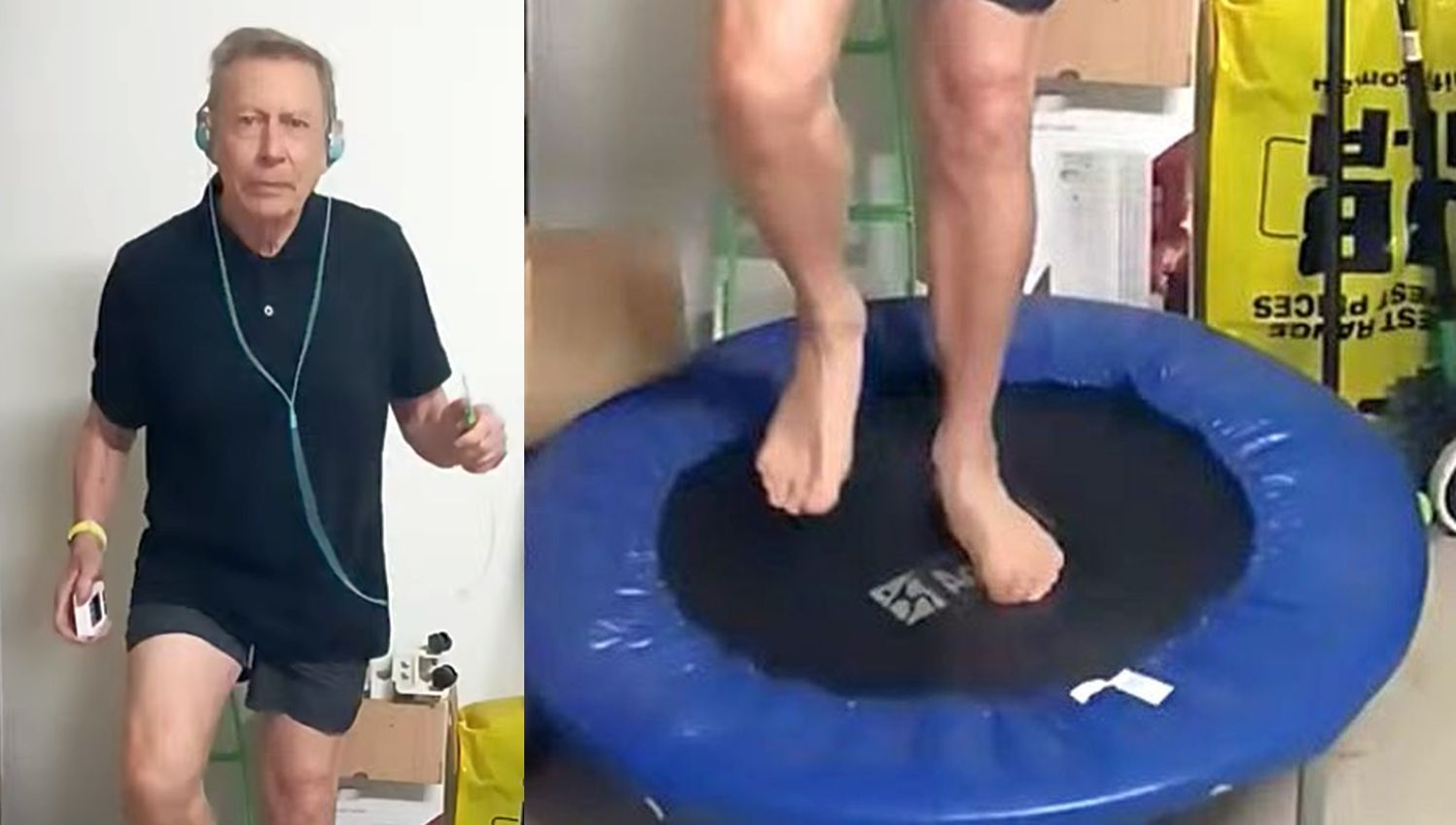
Now at the ridiculous age of 80 years, by all convention and the visible evidence of age peers I am supposed to be a shuffling human wreckage paying some helper to cut my toenails. My mind should be a blurry loop of forgetfulness. I should be living on a cabinet full of medications, and expecting a date with the crematorium at any moment. I am, after all, only a few months older than Donald Trump, and look at him. Yes, perhaps that decrepit fate is around the next corner. As it happens, at least for now, each morning I climb 800 steps, run for a total of 20 minutes on a trampoline at intervals through the day, take long walks, and do 80 pushups. Is this relative age fitness just biological luck or accidental? It could be of course, but life experience suggests not. My father died at 58 from cigarettes, alcohol, anger and hopelessness. I’ve made a series of different choices. An agnostic mind, open to new possibilities, has had a lot to do with it. It is true that I'm a single case study, not a statistical cohort. What has worked for me might not work for you. It is up to you to experiment.

Torrens Riverbank Steps
I approach life now as an experiment, but not an experiment without direction. Having an open mind is different to drifting from day to day with no mental framework for organizing your time. Habits, for example, are one such type of framework. Some people are dogmatic about their habits, good and bad. Others are more adaptive as the world changes, without being just random.
Our tiny lives hurtle into the void of galactic space. Each sunrise should we just jump and scream? Or can we try to work out some kind of general adaptive mental framework to help handle this life journey? Each of us will have a different answer to that. For some it is the comfort of a religion. Not for me. After decades of dead ends and crashes - I'm a slow learner - I have figured out something which works for me. You might or might not find it useful. What follows is not guru stuff. It is just an example. Feel free to adapt whatever you find relevant.
I have formulated a couple of protocols to structure what you might call an energetic agnostic approach to dealing with an ever changing world, not to mention my ever changing body.
The first protocol is encapsulated by the acronym R.E.A.P.E.R , or Research, Experiment, Apply, Persist, Evaluate, Repeat.
=> Step 1 – Research means finding out everything you can about a topic or an idea. The starting pint might be as simple as, say, keeping lint off your clothes in a washing machine, or as complex as researching a PhD. In this process, keep track of your sources. You might need them later. The Internet is your friend, but use it wisely. (I myself store reference stuff in an offline PIM – personal information manager).
=> Step 2 - Experiment. Muck around with what those Youtube videos say, what professors or doctors told you, what your friends have commented on. Poke any proposal and you will find disagreement about what it means. Be a little skeptical. What biases emerge when you follow the money trail etc. ? Try out your own variations.
=> Step 3 – Apply what you have concluded so far. Once you think you can now justify your new idea or plan, find the energy and time to apply it. I didn’t just think that it might be good for my health to climb 800 steps every morning, and put it on a bucket list. I rearranged my life to catch a train into Adelaide CBD every morning, walk out the back of the train station to the Torrens River, then climb up and down 40 riverbank steps twenty times, two at a time. It turned out to be very worthwhile. Without doing it I would never have been sure.
=> Step 4 – Persist. The YouTube gurus who say you can learn Chinese in a month, fix every pain instantly by rubbing it with a dessert spoon, or build a new veranda in a weekend are lying. Things take time to fix, to grow or to make. If you want to change your body it will take months at least. The scale of your ambitions might be important to outcomes here. If you want to change the world, half the world will fight you, so you had better come prepared. Persistence without becoming dogmatic is probably the biggest challenge to keeping an open mind. On important projects, as time passes sunk costs rise, and the tenacity of opponents can drive the protagonist into a stubborn corner where it becomes very hard to admit the need for some changes. (Exploring this dilemma is worth a separate discussion of its own).
=> Step 5 – Evaluate. So your new routine seems to be working OK. The career move you planned is turningout fine so far. The diet you have developed is not killing you and seems to be helping. Don’t leave it at that and stumble along the same path for the rest of your life. The world is changing around you, your body is changing, new and better things are being invented. From time to time stop and review where you have come from, what you are doing, and what might be better if you tweaked or modified it.
=> Step 6 - Repeat. This means to repeat R.EA.P.E.R. itself. Where else can you apply it in your life, in your business, or perhaps give your friends some new direction?
OK, here is an explicit personal example of applying R.E.A.P.E.R. Sometimes saving the world is too hard, but some clear eyed, agnostic thinking for self-rescue is worth a try. Here is my solution to one problem. By now you are surely sick to death of my self-proclaimed exercise routine, but I can’t resist giving you the acronym to another short routine I have already alluded to : S.I.M.E or Short Interval Multiplier Effect. In this case S.I.M.E grew out of the general R.E.A.P.E.R. philosophy.
I was forced to invent S.I.M.E as a veteran of 60 years of almost daily 10 km runs. Finally, age or maybe a wrong running technique, extracted revenge. It the end of 2023 something in one of my ankles suddenly gave way. There was no easily visible damage, but the pain was real. As usual in my experience, doctors with their platitudes were useless, and a catalogue of fix-it Youtube videos only gave hints. For two years the damned ankle kept relapsing.
I sat down and thought it through from first principles: a) My instinct as a distance runner was to overdo it; b) the ankle now hated the impact caused by running; c) the usual low impact solutions like bikes and elliptical trainers only addressed a narrow band of muscles in one dimension; d) I was determined to keep fit.
=> Applied S.I.M.E. solution : a) I hit upon the realization that 5 minutes of exercise 4 times a day was just as good as 20 minutes continuous. Research confirmed that such intervals are actually more effective. b) Running on a trampoline allowed full body movement in all directions and eliminated the impact problem.
=> Outcome applied : 5 minutes of trampoline running 4 times daily.
=> Persistence : The daily protocol has worked well for the past four months.
=> Evaluation and adjustment: After a month I modified each 5 minute set I to include 2 minutes of maximum speed separated by a 1 minute recovery. I also added 20 pushups after each 5 minute set.
=> Extension: Where else in my life can I use this SIME idea? I'm now applying it to my pathetic attempts to learn Mandarin Chinese, for example on the 12 minute train journey in each direction each morning ...
The Dilemma of Choice among a Tangle of Roads to Nowhere Known
We rarely face problems that are entirely unique. Someone has been here before us, staked out the territory and laid claim to their version of truth. We have to tolerate that, but might personally prefer a different conclusion. For example, here is are three networking diagrams. You can find the illustration on many websites. It's creator was attempting to teach technical students about the various kinds of networks they might come across. I took one look and immediately thought of something different. I saw an illustration of competing solutions, none of them wrong, but with different outcomes. All of these solutions connect the same number of dots and those dots are in the same place. Consider the implications of that.
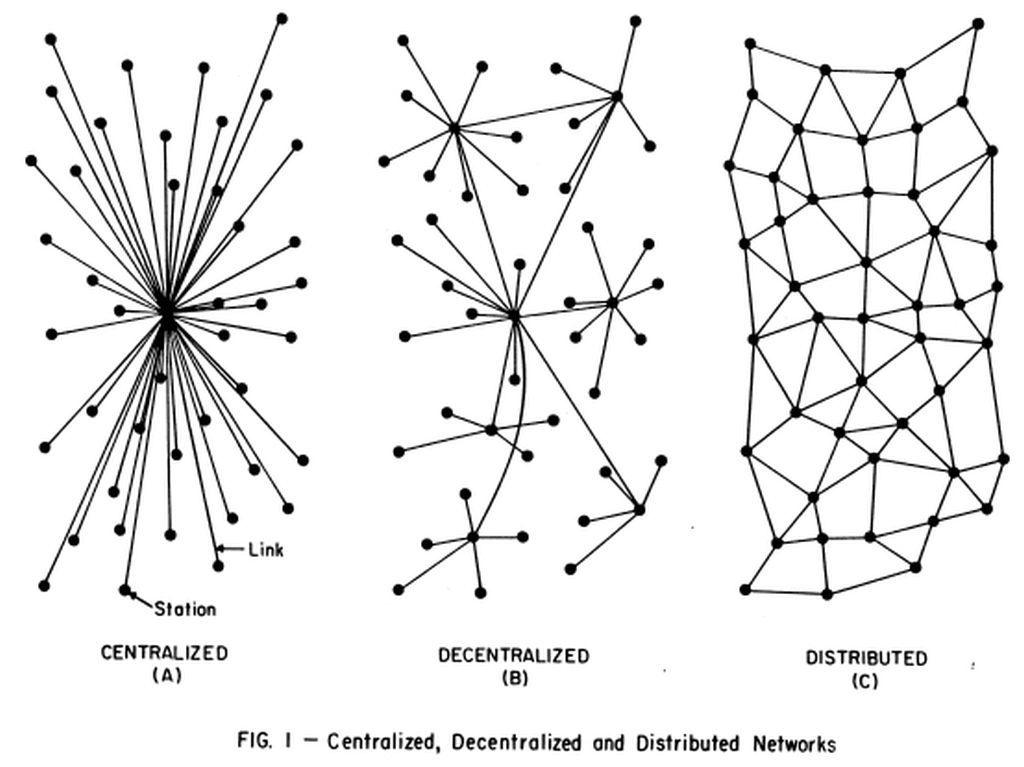
Supposing we are students of human religions. Diagram a) might demonstrate the idea of one all knowing, all powerful god to which all things are accountable. Say, the Christian or Muslim kind. Diagram b) might be a demonstration of semi independent gods who are still bound to one centre. Think for example of Greek and Roman gods. Diagram c) might demonstrate a more distributed pantheistic view of spirituality where everything is ultimately connected but not in an hierarchical way. An argument can and has been made for all these understandings, all starting from the same basic nodes of the human mind.
Or supposing we are researchers debating competing theories of some natural phenomenon. Just as in religion, a truly agnostic approach is actually rare. Scientists say that they are evaluating hypotheses. In reality, again and again they are actually captured by hypotheses, especially if a research grant or the likelihood of publication is involved. For example, I mentioned that I ultimately walked away from two doctoral dissertations in theoretical linguistics in the 1980s & 1990s. At that time the ascendant model of how the brain makes natural language was called generative grammar (after Noam Chomsk's MIT thesis). I became skeptical. It looked like one of those self-validating intellectual bubbles. My supervisor at the time was a clever American with two PhDs and a mind like a railroad track. Generative grammar had to be right, he argued, because all the evidence fitted, all the dots connected. In his view, there was no longer room to be agnostic about this. Hmm, nowadays all kinds of other evidence shows that the Chomskyan framework isn't how human brains work. But the supervisor had a career and I didn't. Persistent agnosticism can be a risky choice.
7. Do We need a Resting Place among Friends, where Doubt is Put Aside?
For most people most of the time it seems that shared certainties are way more important than making space for that restless mind who wonders what is outside the warm living room, and wants to open a window to let winter air come rushing in. Maybe we do need to acclimatize to what is coming. But we won't, not most of us ... not until it is too late.
Even for wandering souls like mine, now and then there comes a time, just a short time, when we dare to pretend that some greater purpose is in play. We might half persuade ourselves briefly that something out there can tell us what it is all about. In one of those moments, long ago, I wrote a little poem:

Adrift
Welcome traveler, to my hearth
Where you may stay awhile and find
What you may find.
May I bring you peace, as you bring light.
A small gift I ask, a vision,
A moment of your forever,
While you pause;
For the walls of my dwelling are shadows
And though you rest upon the certainty of my flesh
In the void of time my heart is adrift.
So tell me traveler, what you see here
Where I cannot see at all.
A mist? A gulf of flame? A meadow?
A working man? A king? A prophet?
What is my quest? Who is my guide and companion?
Am I cocooned in an eddy of four dimensions
Or riding cowboy on an avalanche of stars?
For only a moment traveler, you are real,
And so I ask,
While God forgets to draw his hand
Like a veil, across your face.
Links to a few of Thor May’s articles which have a bearing on the talk topic:
1. Thor May (July 2025) "Why Religion is Like Football, TV, and a Drink Down the Pub" @ https://www.academia.edu/136861956/Why_Religion_is_Like_Football_TV_and_a_Drink_Down_the_Pub
2. Thor May (November 2024) "Why religions are sometimes necessary, and the gods even more so" @ https://www.academia.edu/125437962/Why_religions_are_sometimes_necessary_and_the_gods_even_more_so
3. The Agnostic's Survival Manual http://thormay.net/unwiseideas/TheAgnosticsSurvivalManual.htm [an eclectic collection of about 20,000 words, scratched down over the years and sometimes contradictory]. PDF at https://www.academia.edu/3486693/The_Agnostics_Survival_Manual
4. Does religion emerge as a product of complex systems? – exploring an allegory http://thormay.net/unwiseideas/Religion.htm . PDF at https://www.academia.edu/9924682/Does_religion_emerge_as_a_product_of_complex_systems_exploring_an_allegory
5. The peculiar interest of god(s) in human morality http://thormay.net/unwiseideas/peculiargod.htm . PDF at https://www.academia.edu/19528937/The_Peculiar_Interest_of_God_s_in_Human_Morality
6. Unseen Grammar - Suspecting the God of Cracks Between the Floorboards http://thormay.net/unwiseideas/godofcracks.html . PDF at https://www.academia.edu/2312782/Unseen_Grammar_Suspecting_the_God_of_Cracks_Between_the_Floorboards
7. What will be the dominant ideologies of the 21st Century? PDF at https://www.academia.edu/5681348/ . PDF at https://www.academia.edu/5681348/What_will_be_the_dominant_ideologies_of_the_21st_Century
8. Super-Culture And The Ghost In The Machine http://thormay.net/unwiseideas/skeptic/philos7.html . PDF at https://www.academia.edu/3653431/Super_Culture_And_The_Ghost_In_The_Machine
MEETUPS ORGANIZED BY THOR MAY
i) Adelaide English Conversation Practice - this is designed for people using English as a Second Language. ( https://www.facebook.com/groups/1678127882281980 )
ii) Interesting Topics Online, now run on Zoom every second Tuesday evening ( https://www.facebook.com/groups/1668079356593059 ). Interesting Topics has been running since 2011 under various names (mostly Active Thinking), firstly in Brisbane, then in Adelaide, Australia. It has become extremely unpopular since it turns out that only a vanishlngly small number of people are interested in any idea or opinion which is not their own.
iii) Interesting Topics Live - a Thursday evening cafe version of Interesting Topics ( https://www.facebook.com/groups/497784706090301 ).
Thor May's Websites
i) The Passionate Skeptic - https://thormay.net [legacy]
ii) Academia.edu repository - https://independent.academia.edu/ThoroldThorMay [150+ articles]
d) Contact: thormay@yahoo.com ; https://www.facebook.com/thor.may.7
The Energetic Agnostic © Thor May 2026