|
The two paths
to a quiet life are to say nothing to anybody about anything, or to
say everything that comes into your head. The second way is easily
the most effective. Sooner or later the absolutely discreet person
will be blackmailed or persecuted for something they didn't say. However,
the purveyor of utter candour is regarded with mute horror by all dignified
persons, and given a wide berth. Thus, like much else on this website,
the Brief Ideas have done a great deal to guarantee Thor perfect social
obscurity ....
Health Warning
Aphorisms are supposed to be crisp and wise. Hmm, there is duplicity in simplicity, and turmoil in quietude
.. but the unlucky Chinese actress who uttered those words was sent to
a prison camp by Mao Zedong's bad, mad wife. So take care. Thor's brief
ideas aren't always, or even often wise, but you can clean your teeth
on them, and then decide whether to swallow. They aren't always crisp
either. That comes from being a sludge, not Oscar Wilde. In fact, a lot
of the squeaks and squiggles below are cut down versions of longer
arguments that your can find in Thor's Unwise Ideas, Thor's Agnostic's Survival Manual, and even from an autobiography in rough verse, The Wrong Address.
Maybe all an aphorism reveals is it's author's mind. Looking at this
stuff, I don't always admire what I see, but there comes a time when
you stop apologising for whoever you happen to be. Enjoy.
Beginnings
Thor @1 November 1991
I
don't care what you believe in, so long as you don't believe in it too
strongly. A belief is a weapon in the armoury of your heart, and its
razor edge will murder the innocent. The ice, the fire of your passion
will seduce mundane men and women. Your clarity will excite respect.
And the first demagogue who comes along with a key to your heart's
armoury will wrest the weapon from your moral grasp. The first cause
which wears the colours of your belief will enlist you as a soldier in
ravaging crusades. Peace friend. Keep your passion to doubt with. Our
civilization is a simple matter of live and let live, of giving dreams
a go, but stepping back with a wry smile when we get it wrong. Let the
fundamentalists perish in their own pillars of fire. Spare a dollar for
the living, and have a nice day. Doubt well,
do what you can, then let it be. Presidents, priests, wage slaves,
hustlers, men and women, kids, we all live by the grace of those we
love to despise...
274. Nations of urban peasants
14 January 2017
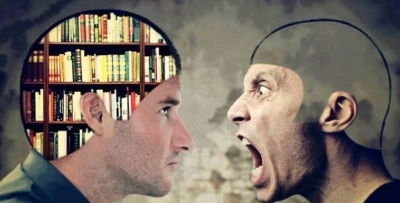
Nations of urban
peasants: the nightmare that no politician will talk about. You never
read about it in the media. Facebook depends upon it, but never gives a
hint. Prisons are full
of it, unemployment queues are made of it, societies would be utterly
different without it. What is this demon that cannot speak its name?
Ah, you don’t want to know. It’s not sexy, but I’ll tell you anyway.
ILLITERACY. You read this far, so you can read a bit. You are ahead of
the pack. Most people can add 2+2, but they find maths hard. Most
people can sign their names, but they find reading more than a few
words hard, very hard.
Half of the people in America, and Australia (and any ‘advanced’ nation
you care to name) cannot read a medicine bottle label or a train
timetable. Think about that. Most managers want “executive summaries
- because they are busy”. The truth is that they cannot take in complex
documents. it is a world too complex for the many. Our governments and
companies are teetering atop computing systems, many written by 900
blind
monkeys, that their principals have no idea how to direct or fix. It’s
too hard. You want democracy? - then get yourself a fully literate
population. But can that even be done? https://literacyproj.org/2019/02/14/30-key-child-literacy-stats-parents-need-to-be-aware-of/
____________________________
273. The face of an
imperfect man
21
October 2016

In
every area of human activity there is endless humbug. This comes from imperfect
or incompetent you and me trying to hold down a job, make a dollar or retain
some shred of self respect. The character differences among us are not about
the humbug, which is almost guaranteed in some form, but our place on the scale of good
humour to pomposity where we defend not being superman after all.
____________________________
272. Somebody else does it better, but ..
10 August 2016

Whatever
you try in life, there are always some people who do it better, and
usually zillions of people who do it worse. Sometimes there are
zillions of people who do it better and a few who do it worse. You can
shift these positions a bit, but advancing on your own abilities is far
more important.
____________________________
271. Willing servants
26 April 2016

Any
large organization, whether government or private, can always find
clever agents eager to disregard the greater good, even when their
actions devastate whole communities. While their season lasts, these
agents will be the paragons of the age.
____________________________
270. Something more
29 September 2015

The
only course, diploma, degree .. worth doing is one where you walk away
wanting to know more, and equipped with questions that will lead you
further. A system which "produces graduates" who are now certified as
"education completed" has failed utterly to produce anything but
production line robots. Institutions where tick-box "competency
curriculums" and compliance checklist teaching rule are incubators of
incompetence.
____________________________
278. Idiots
28 September 2015

On
any issue at any time, half of the population in any country are
idiots. The problem is that different people are idiots on different
issues at different times. What are the odds of finding a leadership
group who remain non-idiots on all issues all of the time?
__________________________________________________
277. Democracy – Comment on a Proposal
April 2014

The
actual management of social, economic and political choices which are
of citizen interest is at the heart of the governance problem, whether
it is some kind of democratic governance or a more arbitrary
alternative. Votes offer an option of yes or no. Life is harder than
that. There is an inherent problem with binary choices in a complex
society. Most important questions are nuanced. We could take almost any
votable question and find within it a host of other questions. Most
respondents will not have the imagination to see the impinging issues
on the lead query. That is their responses will be shallow, and in any
real political campaign easily swayed by partisan argument. ...
continue reading
________________________________
276. The Mental God Bot
Sat 01-Feb-2014

lmost
every kind of god seems to be somebody's favourite. Most of them make
an easy target for satire. Explanatory evidence for a gent on a
thundercloud seems to be thin in the air after all. Yet a perfectly
reasonable account of one kind of god is available from a careful
observation of the human mind. Firstly it is clear enough that
consciousness is a mere pinprick of light illuminating one fraction at
a time of the myriad computations in our brains. Secondly most
philosophers agree that there is no single "I" or self. Our lives
involve multiple roles, and the fragment of consciousness which becomes
"I" in each of them can be quite distinct. Thirdly, our behaviours
often involve role playing. We typically have a superordinate self
behind the mask editing what is presented to the world. Finally, given
this fragmentation of self, it may be a small step to construct a
superordinate "bot", a kind of mental agent, to provide a private
integration and rationalization for our diverse identities. It might
make sense to call this superordinate agent bot "god", and make even
more sense to identify it with a socially advertised supreme being
called "God". That is, the public God offers a very reassuring identity
and validation for all the private gods of individuals. The individuals
in their private subjective worlds can reinterpret the public God for
private convenience without fear of rebuke. They may not even be
conscious hypocrites, but from the evidence of history they will defend
to the death that socially shared public version of their God.
________________________________
275. Live and Let Live
29 December 2013

They
may not be your kind of people. They may not even be my kind of people.
Come to think of it, I'm probably not your kind of person. Whatever.
They, you, me - we've all been here since the (human) world began, or
at least yobos like us. No religion, ideology, culture, reign of
terror, or advertising agency has ever been able to change the whole
daggy mix. So what do you want to do about it? Stand on a street corner
and preach to the converted? Retreat to your limousine and sort them
into your superior type and the other trash? Be a predator to prey on
the unwary and unwise? Screw anything that moves and get wasted while
the party lasts? Hope for a safe life of suburban gossip, the small
world of office hello-friendships and fear of the tabloid murder rate?
Well, it's your call. Me? I'm glad that it takes all kinds of people to
make the world go around. There would be no stories without them. I
don't do bars, usually, but I understood my father who used to say
before stumbling off to find a new dive, desperate to escape his
desolate home life, "gotta go check out the local wildlife".
________________________________
274. Come the Revolution
1 December 2013

You
talk too much about what you've seen and what you think. While the
mafia are still in charge of the asylum they will find a law to bury
you alive (McMillan-Scott, Edward MEP (n.d.) "Liu Xiaobo: biography". Charter 08 for reform and democracy in China website, hosted by the European Parliament, online @ http://www.charter08.eu/5.html or Escobar, Pepe (August 2, 2013) "Our man in Moscow". Asia Times, online @ http://www.atimes.com/atimes/World/WOR-01-020813.html ).
Come
the revolution they will kill you first. You are knowledgeable,
tolerant, polite, politically aware. You are a reasonable alternative.
Reasonable alternatives are a mortal threat to revolutions (Barnard, Anne - November 30, 2013 - "Syrian opposition frays as disillusion and exhaustion take hold". Brisbane Times, online @ http://www.smh.com.au/world/syrian-opposition-frays-as-disillusion-and-exhaustion-take-hold-20131129-2yh36.html#ixzz2mAl8XnQt ) .
________________________________
273. What Is Going On Here?
Thu 19-Sep-2013
 Because
they are mega-everything, states like China and the USA become test
paradigms for what can go right and wrong in managing humans. Consider
these: Because
they are mega-everything, states like China and the USA become test
paradigms for what can go right and wrong in managing humans. Consider
these:
1)
The US has the world's largest and most sophisticated assembly of
spying organizations. They collect what is laughably called
"intelligence" on all of us, legally and often illegally. However this
vast mass of intelligence assets has repeatedly been unable to
anticipate attacks upon its own integrity by its own personnel (who are
surely more spied upon than anybody else): in the first instance from
information leaks by thoughtful and conscientious insiders (Manning,
Snowden, John Kiriakou ... there are others too), as well as from a
long history of soldiers shooting fellow soldiers; or on a much larger
scale from the "war on drugs" - read failure to evaluate the real
meaning of "intelligence" from massive surveillance - which has
generated an explosion of violence and criminality (shades of the
1920s-30s Prohibition); and of course a from long list of wars with
failure sourced in endless misinformation and self-deception; and about
to break: a tsunami of lost business for US corporations which are now
regarded as agents of US spying and no longer trusted worldwide.
2)
The US has the world's most "sophisticated" health care system. Result:
also the world's most expensive health care system. Its outcomes have
resulted in rising mortality, an increase in diseases, and ever-falling
life expectancy for US citizens relative to those in other countries,
and about 62% of bankruptcies due to medical emergency (so this is
"intelligence"?).
3)
The US has the world's best universities. A few. It also has one of the
world's most fragmented and least successful education systems amongst
advanced nations, with graduates indebted for decades. It would be
tiresome to list the failures here, but basically the mess is an
ideologically driven, hysterical melt-down, best understood by the
populist contempt for teachers.
Issues 4), 5), 6) ... why go on?
So
Dagwood Bumstead, prepare a simple solution, an executive summary in 50
words or less for your lobotomized neighbourhood director... Well Mr
Dithers, the problem is partly that nobody really knows how to manage
anything as complicated as a large, technically advanced country. Spin
doesn't cut it. Exceptionalism is another word for arrogance. But there
are other basic missing ingredients too, such as out of fashion ideas
like honesty (from which comes real trust), genuine respect for others
(don't spy on them), cooperation (not coercion), and actually wanting
to do your job well (CV fluff and salary level are not evidence). Oh,
and leadership the rest of us can believe in…
272. God, defined
Wed 04-Sep-2013

God
: definition: A form of socially shared delusion implying a sentient,
omniscient, omnipotent, non-human force which is nevertheless concerned
with human actions. Often used subconsciously by individuals to avoid
ego responsibility for certain thoughts and actions. Used socially by
power seekers as a proxy to validate and enforce control over the
thoughts and behaviours of others. Often a convenient metaphor or
figure of speech to indicate a totality or unseen force, and used as
such even by those uncommitted to any religion. As a sociological
phenomenon the complex God symbol has much in common with other symbols
of absolutist ideology (e.g. in modern times, Communism, Capitalism ..
etc). Ideological symbolism, including the God delusion, is often
defended violently since it becomes entwined closely with feelings of
personal identity and group identity, as well as reflecting much shared
cultural behaviour. In many jurisdictions God/Ideological symbolism is
constructed into formal provisions of community law and used to divide
good (those who comply with the entailed beliefs and behaviours) from
bad (those who do no comply with the entailed beliefs and behaviours).
In all national and cultural jurisdictions large numbers of pragmatic
individuals have always remained silent in private rejection of widely
accepted God/Ideological belief and institutional frameworks since for
social and professional reasons a public challenge would usually yield
little personal advantage, but ensure significant personal
disadvantages.
________________________________
271. Security & the Neo-feudalists - One Dimensional Chess
Sat 03-Aug-2013
 A
few centuries ago Europe was dotted with castle fortresses, surrounded
by supposedly impregnable stone walls and moats of water. Barricaded in
these castles were lords and ladies, sucking the life out of the
peasant farms around them, and blowing the surplus on weapons, wars and
gluttony. They were war-lords, or in modern parlance, mafia godfathers.
Their current incarnations are a bit more complicated. They go by the
names of presidents, prime ministers, corporate chieftains etc, but
their fantasies and fears are still essentially feudal. "Security" is
their obsession. Day and night they fear for their own arses, while
whole populations are conned into paying the bills for their depravity.
And as in the Middle Ages, these neo-feudalists gold-plating their
scorpion nests in Washington, Beijing, Moscow etc have induced new
breeds of outlaws. For every action in nature, there is an equal and
opposite reaction. A
few centuries ago Europe was dotted with castle fortresses, surrounded
by supposedly impregnable stone walls and moats of water. Barricaded in
these castles were lords and ladies, sucking the life out of the
peasant farms around them, and blowing the surplus on weapons, wars and
gluttony. They were war-lords, or in modern parlance, mafia godfathers.
Their current incarnations are a bit more complicated. They go by the
names of presidents, prime ministers, corporate chieftains etc, but
their fantasies and fears are still essentially feudal. "Security" is
their obsession. Day and night they fear for their own arses, while
whole populations are conned into paying the bills for their depravity.
And as in the Middle Ages, these neo-feudalists gold-plating their
scorpion nests in Washington, Beijing, Moscow etc have induced new
breeds of outlaws. For every action in nature, there is an equal and
opposite reaction.
For the storytellers amongst us, the present disorders humbling those who would be gods is a rich harvest of irony. A
while back, we had hopes for Barack Obama, but he turns out to be
another sock puppet, with his minders, the generals and the
money-lenders, tussling inside his sock. The greatest cheat-game in
history, new toys to steal the private lives and secrets of everyone on
the planet (Prism, NSA XKeyscore etc), has been busted wide open by a
gent called Edward Snowden, dismissed as a lowly techie. It turns out
that Snowden was a systems design analyst, tasked with finding
weaknesses in the whole monster machine. He had keys to every door in
the castle, and horror of horrors, genuine intelligence. Unlike the
lawyers and MBas who pretend to "manage" our civilization, he actually
understands both the politics and the technology. He skipped ahead of
them to Hong Kong, from whence the Washington lords, consumed by their
own arrogance, drove him to Moscow and forced him to stay there. They
forced a man like Snowden, awash with all their security secrets, into
the arms of a spymaster like Vladimir Putin. Now there was brilliance,
duh? With half a brain between them, they could have let Snowden slip
off to South America and picked him up easily. Instead Obama and his
military minders have proved conclusively that they lack the
competence, integrity and calibre to manage or interpret the torrents
of information about all of us which they have stolen. There is a
theory going around that somebody in this game is playing
eleven-dimensional chess, Matrix style. If so, Snowden and Putin have
outclassed the Washington scorpions on every move.
________________________________
270. King Kong and Big Data
Mon 22-Jul-2013
 Big
data is an enabling technology. That is, it enables both risks and
rewards, according the skills and judgements of those who engage it (http://www.brisbanetimes.com.au/it-pro/business-it/how-big-data-can-result-in-bad-data-20130720-hv11k.html?rand=8744926).
Human beings have never been known to turn down an enabling technology,
regardless of the consequence that it will enable catastrophes as well
as rewards. Big
data is an enabling technology. That is, it enables both risks and
rewards, according the skills and judgements of those who engage it (http://www.brisbanetimes.com.au/it-pro/business-it/how-big-data-can-result-in-bad-data-20130720-hv11k.html?rand=8744926).
Human beings have never been known to turn down an enabling technology,
regardless of the consequence that it will enable catastrophes as well
as rewards.
Take the
motor vehicle: “There have been more traffic related fatalities around
the world, since the first automobile was made, than all the deaths
from all global conflicts over the past 3000 years combined” (http://www.shaundejager.com/psychology-of-our-driving-culture-affects-our-safety/).
With cars the carnage has been sufficient for us to impose some burden
of legal care on drivers (without stellar success). No such sanction,
or even systematic care, is ever likely to be the case with the
potentially catastrophic misinterpretation of big data by hamburger
driven office workers.
Edward
Snowden is right: by collecting limitless data on all of us, the
American “security” juggernaut, Prism, and its industry analogues, have
limitless potential to generate expensive errors or even tragedy
through the poor judgements of misguided human controllers. At a
national level, Australia is deeply enmeshed in the activities of the
United States Defense establishment’s big data plays, both because of
the wholesale plundering of our private and business communications,
but formally through intelligence establishments such as those at Pine
Gap (http://www.brisbanetimes.com.au/it-pro/security-it/australian-outback-station-at-forefront-of-us-spying-arsenal-20130720-hv10h.html). That is, whatever brings those bunnies to grief in the name of security will also bring us to grief. Not if, but when.
________________________________
269. Almost the same, almost forever (but not quite)
Fri 19-Jul-2013

Nothing
in nature ever repeats itself. Not quite. No two heartbeats are ever
the same. No two orbits of the earth around the sun are ever the same.
No two human faces are ever the same, no two trees, or rocks or even
motor cars. Often the differences are tiny, infinitesimal. We live
comfortably expecting the sun to rise tomorrow. Yet no mathematical
equation can predict when the orbit of one planet will be just
different enough, will cross a chaotic threshold and spin off into
space alone, and throw us into the eye of the sun. No doctor can
predict when the never-quite-the-same oscillations of your heart muscle
will become chaotic and kill you. And no fortune-teller, priest,
politician or scientist can navigate you to a heaven in this life or
any life governed by the whimsical paths of strange-attractors.
________________________________
268. Trouble with the Sock God
Mon 08-Jul-2013

Have
you noticed? It's the small gods who always make trouble. Take the Sock
God. Without fail, each time I wash clothes, the Sock God sneaks in and
steals a sock. Once I tried to beat the bugger by buying all black
socks, so I could match the orphans. Nope. You wouldn't believe how
many shades of black there are. Then there is the Street God. A street
can be completely empty. Then as soon as I want to cross it on foot,
three cars, a motorcycle and an ambulance will appear from all
directions. Now you know very well that if you decide to pay for
something with all the metal collecting in your pocket, the Little
Money God will howl with laughter and make sure you are 5 cents short.
Then, reluctantly using a $5 note, the shop girl will find that she has
to give you $3 of change in 10 cent coins. Oh, and never, ever hint to
yourself that something is important or urgent to do. A merry team of
Trip Up Gods will make sure that forget to bring your wallet, twist
your ankle in a rush, and find that the subway line is closed for
maintenance. What kind of mischief will they have for us when we
finally get to heaven?
________________________________
267. All hidden truth to bring to light
Mon 01-Jul-2013

Art
is not a part of things until we make it a part. An artist is someone
with the skill of helping others to see the extraordinary in the
ordinary. She finds a symphony in nature where others have heard only
noise. The beauty of science, or mathematics is not in making new
truths. They were there waiting to be found, and an extraordinary
person has shown us where to look. The gift of teaching is not in
repeating words from books, but in surprising students with the sudden
knowledge of their own power to understand. Then words half formed, obscurely muttered, became perfect and were clearly uttered. [Odin's song, the Icelandic Edda]
________________________________
266. Pity your neighbour's cat
Mon 10-Jun-2013

The most
certain quality of power is that those who seek it will misuse it. A
second certainty is that an army of zombies will eagerly imitate their
leaders. And so it is with "cyber warfare". Government leaders
routinely spy on you? No problem. (http://www.brisbanetimes.com.au/it-pro/security-it/alarm-bells-ring-as-power-of-data-miners-starts-to-compute-20130609-2nxvj.html
). Anyone from the janitor in your local primary school, to the
supermarket checkout girl, to every fool called "manager" will now feel
free to watch you through a crack in the door. They will hasten to be
fashionable spies, and at the first chance snitch on you or your
neighbour's cat.
________________________________
265. The Limits of Education
Mon 20-May-2013

"Education does not make us educable. It is our awareness of being unfinished that makes us educable." ~ Paulo Freire, Pedagogy of Freedom.
How much time have you invested in education? How much value has your
education given you? How would you measure the value? I hung around
universities and schools in the hope of growing my ideas. It took me
way too long to realize that schools and universities were not there
for that. In fact, most of the people who went to these places, and
most of the people who taught in them, were not interested in growing
ideas. They wanted dollars and respectability. Their aim was to become
"finished", and sure enough a diploma nearly always finished them.
Their curiosity died. As finished people they could get jobs, have
babies and grow fat. Some of them (like doctors) took a long time to
get their diplomas, but somehow this didn't make any difference. In the
end, maybe 80% of them scraped by rather badly in their jobs from day
to day, maybe 10% were so hopeless that they were a menace to everyone
in the neighbourhood, and maybe the top 10% were ace mechanics,
lawyers, salesmen, or whatever. Me, I've successfully remained
unfinished, unemployable, curious, poor, and boring to all of the
finished people around me.
________________________________
264 Evidence - The Alchemy of the Ages
Mon 13-May-2013

What do politicians, voters, the captains of industry, drug companies,
priests and door-to-door salesmen all have in common? Not much.
However, every one of them has an addiction to evidence. Not any
evidence. The evidence they crave (and will pay a king's ransom for) is
evidence to support their cause. So what is this mysterious thing
called evidence? Evidence is the magic emerging when A together with B
seems to result in C. A and B are then called "premises" to the logical
(?) outcome, C. That is, A and B are evidence which "prove" C. In real
life, C is what the politician, the voter, the priest, or whoever ...
wants to hear. The general idea is that when you have a proof, C, then
other people will believe you. Therefore, if you are smart you will
carefully choose A and B (not K, M or Z) to prove your point. If you
are cheeky, you might even call the evidence "scientific". That is
because the adjective "scientific" has special religious power in this
age. Actually, scientific method (which is understood by about 2% of
any population) starts with the strange idea that the truth of C is
unknown before A and B are put together as an experiment. Even more
strangely, scientific method requires that the A and B premises (or
"variables" as they are called in an experiment) are not chosen to
"prove" C. Rather, any outcome C is only as good as the original wisdom
of choosing the variables, A and B, instead of K, M or Z. At any later
time, K, M or Z might be shown to be better choices, and the original
outcome, C, might be trashed. Well, that kind of science is for geeks.
There is no danger, ever, that politicians, voters, the captains of
industry, drug companies, priests and door-to-door salesmen will have
their more convenient idea of "evidence" share a bookshelf with
fairies, Santa Clause and UFOs.
________________________________
263. When an Arm is not an Arm
Thu 25-Apr-2013

An
arm is not an arm until it attaches to a body and moves in certain
ways. It is the relationship between the arm and the body which makes
it an arm, not a certain weight or shape of blood and bone. This is
really important. Even apparently simple things are more than the sum
of their physical parts. During the course of the scientific revolution
- say the last 300 years - we have squeezed quite a lot of knowledge
out of analysing the parts of things. But this kind of fragmented
knowledge has limits, and we have almost come to the end of it. As a
linguist I can tell you about phonemes and morphemes, or nouns and
verbs and all the rest. I can't quite tell you how their relationships
all fit together to make a functioning language. Any linguist who says
he can is a humbug. There are armies of humbugs (not only in
linguistics). A "language" is an indivisible array of incredibly
complex dynamic relationships. (An average speaker has no concept of
this). A human being is also an indivisible array of incredibly complex
relationships. If you pick up a severed foot or head, it is no longer a
part of a human being. It is a piece of meat. The massive complex of
relationships we call a human being creates consequences which could
never be predicted from the severed head and foot. And so it goes with
the organizations and institutions which human beings develop. A dance
floor is not a dance floor until there are people to dance on it. It is
the relationship between the people and the floor which makes it a
dance floor. Nor is a king a king until there are people who are
willing to obey his rule. Until then, he is just a fool in a funny hat.
________________________________
262. The Factory Makes Six Million Left-Footed Shoes
Thu 18-Apr-2013
 From
early in the Cold War era it became a habit to lampoon the idiocies of
centralized communist planning in the Soviet Union. There was plenty to
lampoon. George Orwell's "Animal Farm", and later "1984" became eerily
predictive. What we never noticed though, deafened by all the
ideological shouting, was that the strengths and weaknesses of
collective activity are found everywhere there are humans. The United
States is on the cusp of decline as a successful civilization exactly
because, for ideological reasons, it manages collective activity very
badly and at vast, wasteful expense. Selfishness and greed, in the end,
don't come cheap. For example, 62% of the bankruptcies in America occur
simply because there has been no well-managed universal health care.
That leads to huge personal and national losses. Not smart. On the
other hand, it remains true that any organization will multiply
individual errors, and resist correction of the problem. If the
organization is a communist state, that multiplication of error can be
catastrophic (as we saw, for example, in China's so-called Cultural
Revolution, which came close to destroying the state altogether). Even
in our modest "capitalist" democracies though, this is a daily problem.
We may have millions of companies, but as in the planned state, they
lock individual faults into a collective framework, and even imitate
the errors of other organizations. Countless millions are trapped in
soul-destroying workplaces where some brainless "authority" figure
micro-manages his small kingdom into a paralysis which can go on for
years. The individual meeting an organization of any size is always at
risk. Recently I had reason to spend a little time in a hospital. On
discharge I was given a document which listed my "co-morbidities" - a
catalogue of terrifying conditions supported by a collection of
life-threatening pills to take every day. It was all pure fiction,
apparently manufactured by some bored muppet in an off-moment. I
protested, and was ignored. The patient is always stupid. The “medical
record” had been created and was sealed with the authority of the
organization. I consulted a GP. We agreed that the hospital was insane
and trashed the pills. I wrote formally to the hospital and
ostentatiously signed it "PhD" for effect. Into the void. The hospital
continues to send letters assuming my pending "morbidity". This is the
story of organizations everywhere, and why, occasionally, there are
revolutions. From
early in the Cold War era it became a habit to lampoon the idiocies of
centralized communist planning in the Soviet Union. There was plenty to
lampoon. George Orwell's "Animal Farm", and later "1984" became eerily
predictive. What we never noticed though, deafened by all the
ideological shouting, was that the strengths and weaknesses of
collective activity are found everywhere there are humans. The United
States is on the cusp of decline as a successful civilization exactly
because, for ideological reasons, it manages collective activity very
badly and at vast, wasteful expense. Selfishness and greed, in the end,
don't come cheap. For example, 62% of the bankruptcies in America occur
simply because there has been no well-managed universal health care.
That leads to huge personal and national losses. Not smart. On the
other hand, it remains true that any organization will multiply
individual errors, and resist correction of the problem. If the
organization is a communist state, that multiplication of error can be
catastrophic (as we saw, for example, in China's so-called Cultural
Revolution, which came close to destroying the state altogether). Even
in our modest "capitalist" democracies though, this is a daily problem.
We may have millions of companies, but as in the planned state, they
lock individual faults into a collective framework, and even imitate
the errors of other organizations. Countless millions are trapped in
soul-destroying workplaces where some brainless "authority" figure
micro-manages his small kingdom into a paralysis which can go on for
years. The individual meeting an organization of any size is always at
risk. Recently I had reason to spend a little time in a hospital. On
discharge I was given a document which listed my "co-morbidities" - a
catalogue of terrifying conditions supported by a collection of
life-threatening pills to take every day. It was all pure fiction,
apparently manufactured by some bored muppet in an off-moment. I
protested, and was ignored. The patient is always stupid. The “medical
record” had been created and was sealed with the authority of the
organization. I consulted a GP. We agreed that the hospital was insane
and trashed the pills. I wrote formally to the hospital and
ostentatiously signed it "PhD" for effect. Into the void. The hospital
continues to send letters assuming my pending "morbidity". This is the
story of organizations everywhere, and why, occasionally, there are
revolutions.
_________________________________________
261. Boo! So What Are You Afraid Of ?
Wed 10-Apr-2013
 What
are you afraid of? If you are under 30 you are probably afraid of being
laughed at by your frienemies, but probably not afraid of burning half
your brain cells and poisoning your liver with booze, or getting an STD
from bad sex. At younger than 30 you are immortal, so you expect to
live with your frienemies forever, but don't expect to wind up in
hospital on an oxygen ventilator, racked with pain and depending for
survival on a daily packet of deadly prescription drugs. If you are
older than 30 your frenemies are probably already married, and too busy
complaining about their mortgage to worry about your haircut. By now
you are not quite as fit as you used to be, and you've had your first
hints of future death. You begin to worry vaguely about pains, pills,
next week's salary, and how you might not be master/mistress of the
universe after all. No matter, if you are older than 15 and younger
than 60 you are scared witless of talking about anything but the
weather, the football and your favourite movie star. After all, who
might be listening? Your Facebook page is a total threat if it contains
anything except photos of you on a sunset beach, or your favourite pet.
Why the terror? That's easy. People used to be afraid of a vengeful
God, the Devil or the Lord of the Castle. Now Godzilla's alias is HR.
Surviving HR permits you to have a "career". Perishing from an attack
of HR condemns you to the charnel house of public charity and pity. HR
is a poisonous cloud which hovers forever between you and the sun. This
HR cloud is made from the acid vapours of statistical averages and
massaged employment prejudice. The once-were-human shapes which come
out the other side of the HR cloud are bleached skeletons, draped in
the rags of fashion, dangling from puppet strings, fitted with voice
boxes from the company store. Of course, none of this is discussed in
polite circles. A Martian might find it hard to understand why the
highest aim of Earthlings is to graduate as bleached bones dangling
from puppet strings. The Martian might not be aware though that the
entire education system, popular media and weight of public opinion is
focused on persuading young Earthling persons that their finest
achievement will be to qualify as bleached puppet bones on a respected
payroll. What
are you afraid of? If you are under 30 you are probably afraid of being
laughed at by your frienemies, but probably not afraid of burning half
your brain cells and poisoning your liver with booze, or getting an STD
from bad sex. At younger than 30 you are immortal, so you expect to
live with your frienemies forever, but don't expect to wind up in
hospital on an oxygen ventilator, racked with pain and depending for
survival on a daily packet of deadly prescription drugs. If you are
older than 30 your frenemies are probably already married, and too busy
complaining about their mortgage to worry about your haircut. By now
you are not quite as fit as you used to be, and you've had your first
hints of future death. You begin to worry vaguely about pains, pills,
next week's salary, and how you might not be master/mistress of the
universe after all. No matter, if you are older than 15 and younger
than 60 you are scared witless of talking about anything but the
weather, the football and your favourite movie star. After all, who
might be listening? Your Facebook page is a total threat if it contains
anything except photos of you on a sunset beach, or your favourite pet.
Why the terror? That's easy. People used to be afraid of a vengeful
God, the Devil or the Lord of the Castle. Now Godzilla's alias is HR.
Surviving HR permits you to have a "career". Perishing from an attack
of HR condemns you to the charnel house of public charity and pity. HR
is a poisonous cloud which hovers forever between you and the sun. This
HR cloud is made from the acid vapours of statistical averages and
massaged employment prejudice. The once-were-human shapes which come
out the other side of the HR cloud are bleached skeletons, draped in
the rags of fashion, dangling from puppet strings, fitted with voice
boxes from the company store. Of course, none of this is discussed in
polite circles. A Martian might find it hard to understand why the
highest aim of Earthlings is to graduate as bleached bones dangling
from puppet strings. The Martian might not be aware though that the
entire education system, popular media and weight of public opinion is
focused on persuading young Earthling persons that their finest
achievement will be to qualify as bleached puppet bones on a respected
payroll.
_________________________________________
260. Trust
Tue 02-Apr-2013
 Do
you trust me? That's a hard call, isn't it. Without trust life is not
easy. Oxytocin is the brain chemical which gives the feeling of trust.
Some people, and maybe some cultures seem more hooked on it than
others. (Whether different cultures are dominant for different brain
chemicals like this is a really fascinating puzzle). So how far can you
trust another person, or institution? It depends on the answers to a
lot of questions. If someone understands some things about you, they
have at least the foundation of trust. They can decide to trust your
skill to kick a football, or reliability to turn up at work on Monday
morning. If they don't understand your thinking at all, they will
hesitate to trust you for anything important (sigh, lots and lots of
people don't seem to understand my thinking at all ...). In that case,
they can only trust from your reputation, and reputations are fragile.
In some jobs, like the police force, they are paid to trust nobody.
Some people, like doctors, we hope we can trust, but experience might
undermine that. In some countries, like Australia, people generally
trust the good intentions of the government (though often distrust its
competence), and often trust the goodwill of strangers. In some
countries, like China, people generally do not trust the intentions of
the government, and don't trust anyone they don't know well. The
general trust between employers and employees seems to have changed
quite a lot in my lifetime (or maybe experience has just taught some
hard lessons!). Looking back, I have to say that most of my employers
have been untrustworthy when it comes to building a future together.
Sometimes they didn't trust me to be cheats like them! Generally the
employers, or their agents, have only been interested in some short
term advantage, often wrangled by lying, like a bad lover on a one
night date. What a pity. Speaking of which, the hardest thing to find
of course are good friends to trust in stormy weather. Do
you trust me? That's a hard call, isn't it. Without trust life is not
easy. Oxytocin is the brain chemical which gives the feeling of trust.
Some people, and maybe some cultures seem more hooked on it than
others. (Whether different cultures are dominant for different brain
chemicals like this is a really fascinating puzzle). So how far can you
trust another person, or institution? It depends on the answers to a
lot of questions. If someone understands some things about you, they
have at least the foundation of trust. They can decide to trust your
skill to kick a football, or reliability to turn up at work on Monday
morning. If they don't understand your thinking at all, they will
hesitate to trust you for anything important (sigh, lots and lots of
people don't seem to understand my thinking at all ...). In that case,
they can only trust from your reputation, and reputations are fragile.
In some jobs, like the police force, they are paid to trust nobody.
Some people, like doctors, we hope we can trust, but experience might
undermine that. In some countries, like Australia, people generally
trust the good intentions of the government (though often distrust its
competence), and often trust the goodwill of strangers. In some
countries, like China, people generally do not trust the intentions of
the government, and don't trust anyone they don't know well. The
general trust between employers and employees seems to have changed
quite a lot in my lifetime (or maybe experience has just taught some
hard lessons!). Looking back, I have to say that most of my employers
have been untrustworthy when it comes to building a future together.
Sometimes they didn't trust me to be cheats like them! Generally the
employers, or their agents, have only been interested in some short
term advantage, often wrangled by lying, like a bad lover on a one
night date. What a pity. Speaking of which, the hardest thing to find
of course are good friends to trust in stormy weather.
_________________________________________
259. What is Your Greatest Weakness?
Mon 25-Mar-2013

A
favourite question in job interviews is "what is your greatest
weakness?" I always find the question puzzling. It is puzzling because
nowadays the person who interviews you is rarely, say, a hard drinking
building supervisor who wants to know if you really can lay bricks. No,
it will be some half-formed cream puff who has never laid a brick, and
thinks that a 'C' pass in Psychology 101 has given them the key to the
human soul. Part of the text book cleverness of these HR persons is to
assume that every person being interviewed is lying. Therefore, to give
a good interview is to impress the HR person is that you can lie cooly,
without a flicker of embarrassment. If you can lie in your own
interests, presumably you can lie in the interests of the company too.
So this is the problem with "what is your greatest weakness?". The
proper answer actually depends upon the fetishes, fears and fantasies
of the HR person. Does he secretly pull the wings off butterflies, or
does she have nightmares about breaking her stiletto heels in an
escalator? Until you have such critical information, you don't really
know which lie will make him/her feel all warm and fuzzy inside ...
_________________________________________
258. From Small Beginnings ...
Tue 19-Mar-2013

Habits
are efficient (.. decide daily which side to part your hair on?).
Habits are restricting (.. do you really need to check Face Book every
ten minutes?). Harvesting the tension between efficiency and
restriction gives life purpose and direction (.. doesn't any industry
do just that?). An imbalance of habit, out of proportion to real need,
becomes a fetish (.. do you really need to carry a lucky charm to that
job interview? Will members of X religion really go to Hell if they eat
A or drink B? .. do you really need to fantasize about Y to get off on
sex?). Shared fetishes may become a cult (.. so do you gather to dance
around a tree on moonlit nights? .. are you compelled to gather in a
TAB betting shop on Saturday afternoons? ). At a critical mass of
members, a cult becomes a religion (.. one believer is a mental case; a
million believers are sure they are right). A religion is a social tool
which comforts the timid and sanctifies the ambitious. A person both
sanctified and ambitious feels no restraint. God or the Party is always
on their side of the war. Any atrocity is possible.
_________________________________________
257. Feeding the Uninvited Guests - Why putting on weight is so damned unfair
Fri 08-Mar-2013

This
is completely unscientific. I don't know the vices of microbes. I am
told that I have tens of trillions of the buggers in my gut, and
through my body. "According to a recent National Institutes of Health
(NIH) estimate, 90% of cells in the human body are bacterial, fungal,
or otherwise non-human" (http://mpkb.org/home/pathogenesis/microbiota
). So there are way more of them than all the cells which make me into
me. I didn't ask them in, and clever scientists insist that I'd cease
to be me if whole armies of these layabouts didn't hang out in the
draughty corridors of my frame. OK guys, so apparently we need each
other. But I have deep suspicions about your habits. You, my frenemy
microbes, get a little peckish and push the button for a bell-hop to
bring in a snack, then another and another. It's worse than that. You
have the hotel manager (ergo, me) so trained as a slave that I bring
you more goo than you know what to do with. By rights that should go
straight down the disposal chute, but no, I stuff it away in every
spare corner, just in case you greedy little sods press the service
bell in the middle of the night. Now I've got your number though, I've
sussed you out. You just love bread, or whatever bread turns into -
probably sugar. I eat a slice of bread and you'll double its weight in
my gut. What are you doing? Breeding like house flies? I dunno', but
I'm damned if I'm going to feed your bread lust. O.K., just a slice now
and then before I rush off to clean my teeth and get the delicious
taste out of my mouth. Hey, I'm winning, you are losing. I've kept us
both pretty trim.
_________________________________________
256. You Want Me to Explain? You must be kidding.
Fri 15-Feb-2013
 There
is an explanation for everything. You know that's true because somebody
always has an explanation. The world was surely created in seven days
because somebody important wrote that in a book. Last week a young
woman of twenty was burned to death as a witch in Papua New Guinea
because a child in a nearby hospital died. In PNG villagers are taught
by elders from childhood that death and sickness is always caused by
sorcery: http://www.brisbanetimes.com.au/world/woman-burnt-for-sorcery-20130207-2e19f.html. From the 1929s to the 1959s American medical doctors endorsed advertisements saying that smoking was good for you: http://www.youtube.com/watch?v=gCMzjJjuxQI
. Who was my father to question medical doctors? In 2013 doctors are
saying that LDL cholesterol causes plaque which causes heart attacks.
This information comes from very important establishment sources like
the American Heart Foundation, which happens to be packed with shills
for large chemical companies which flog statins. The doctors duly
peddle the expensive statins to patients who believe their respectable
doctors. Actually there isn't a shred of experimental evidence to show
that LDL cholesterol causes plaque, and the statins raise, not lower,
the death rate. Cracking that racket is about equivalent to taking on
the armaments industry: http://thepeopleschemist.com/does-the-family-really-need-lipitor-and-aspirin/.
But the underlying pattern has never and will never change. Remember,
in 1633 Galileo was almost put on a bonfire by a supremely
authoritative Catholic Church for denying the sun went around the
earth. It is all your fault. You demand explanations. Yet you are not
really interested in genuine evidence. You are interested in what
important, respectable people say is true, because they can give you
jobs and make you respectable too. Even if you die from smoking, like
my father did at fifty-seven. There
is an explanation for everything. You know that's true because somebody
always has an explanation. The world was surely created in seven days
because somebody important wrote that in a book. Last week a young
woman of twenty was burned to death as a witch in Papua New Guinea
because a child in a nearby hospital died. In PNG villagers are taught
by elders from childhood that death and sickness is always caused by
sorcery: http://www.brisbanetimes.com.au/world/woman-burnt-for-sorcery-20130207-2e19f.html. From the 1929s to the 1959s American medical doctors endorsed advertisements saying that smoking was good for you: http://www.youtube.com/watch?v=gCMzjJjuxQI
. Who was my father to question medical doctors? In 2013 doctors are
saying that LDL cholesterol causes plaque which causes heart attacks.
This information comes from very important establishment sources like
the American Heart Foundation, which happens to be packed with shills
for large chemical companies which flog statins. The doctors duly
peddle the expensive statins to patients who believe their respectable
doctors. Actually there isn't a shred of experimental evidence to show
that LDL cholesterol causes plaque, and the statins raise, not lower,
the death rate. Cracking that racket is about equivalent to taking on
the armaments industry: http://thepeopleschemist.com/does-the-family-really-need-lipitor-and-aspirin/.
But the underlying pattern has never and will never change. Remember,
in 1633 Galileo was almost put on a bonfire by a supremely
authoritative Catholic Church for denying the sun went around the
earth. It is all your fault. You demand explanations. Yet you are not
really interested in genuine evidence. You are interested in what
important, respectable people say is true, because they can give you
jobs and make you respectable too. Even if you die from smoking, like
my father did at fifty-seven.
_________________________________________
255. Age, Ambition and Secret Knowledge
Tue 29-Jan-2013

He
used to be a factory manager. They booted him out, "too old" at 40.
Someone with an MBA said he wasn't following best practice. Best
practice was what a text book said it was, apparently. Actually it
wasn't. The book writer had never worked in a factory. The
too-old-at-40 factory manager had started on the shop floor. He knew
what worked, and his staff knew that he knew. They were a team. The
ambitious new MBA factory manager talked a lot about teams, but he
didn't know about factories, and his staff knew that he didn't know. He
was in trouble, the factory was in trouble. He had to lie about both of
those things because he was ambitious. If you are ambitious you can't
share what you know and don't know. You can't give your personal
competition any advantage. The too-old-at-40 ex-factory manager looked
into his beer sadly. He had always shared his knowledge. That's why he
had a working team. That's why he was now an ex- . Something was crazy
in the world. This is a true story.
_________________________________________
254. Life's Big Tests and Petty Minded Creeps
Fri 18-Jan-2013

Life's
big tests are mostly less about fighting real monsters than finding a
way past petty minded creeps: their shadow monsters are built from
stupidity, ignorance, greed, incompetence, jealousy and cowardice.
Sometimes the toughest part is not being a petty minded creep too.
_________________________________________
253. The Magic Law of Thirty
@ January 13, 2013

Thirty is a magic number. By 30 Alexander the Great was master of his
known universe; (but dead at 33, dummy). So we are supposed to be
master of whatever we are going to be at 30. Well, at least of our
bodies. Isn’t a woman forever an old maid if she hasn’t bagged her man
by 30? A man? Sigh, I had hardly even found an ambition by 30. But I
had learned how to do 30 push-ups, not such a small thing, and later
300 body presses in sets of 30 before getting out of bed every day.
That kept me alive to 60, when you find out about pain in unexpected
places. Therefore – my discovery and gift to the world is … the magic spell of 30 to banish pain.
Here’s how to use it. Whenever the pain trolls creep out of dark places
– a little toe, a sore shoulder, an aching back – experiment, press and
poke, find the muscle angle that brings it on. When you have it, gently
rock in and out 30 times, stretching a little. Abracadabra. The pain
has gone. You have joined the immortals. Hey, it works. Better to
be me than Alexander.
_________________________________________
252. The Moral Dilemma of an Average Man (or Woman)
@Tue 01-Jan-2013
 The
English word "moral" (adj. moral ; n. morality; v. moralize) is not
sexy. It is stained forever with images of self-righteous old men
saying worthy things, then rushing off (from church or wherever) to
lie, steal and coerce the weak in secret. That has been the
never-ending history of poor leadership worldwide. The usual mis-used
tools are propaganda, rules, punishment, ideology and religion. Not
surprisingly, more and more of us have said "enough of this crap!". The
trouble is, we do need something like "morality" to live together. That
is, we need some common sense rules for getting along, being fair, and
putting some limits on what we do to other people, or even to our own
minds and bodies. (Maybe somebody should invent a new word for this
stuff). Most of the time, most of us do pretty well. Otherwise we would
have killed each other off long ago. However, there is no doubt though
that some people go off the tracks more than others, and at certain
times in history whole cultures go a bit crazy. War is the worst
example, but any culture or subculture may also have plagues of bad
behaviour. American merchant bankers come to mind. Mainland China at
the moment is at a pretty low point (it is not alone of course). There
is almost no public trust in China now, and the president of the
Chinese Academy of Social Sciences, Li Hanlin, has just concluded from
a study that "fewer than 4 in every 100 people surveyed said they had a
clear concept of what social morality meant, while more than half
believed that nowadays China has no specific moral standards to be
followed." (http://usa.chinadaily.com.cn/china/2013-01/01/content_16073536.htm).
That certainly states the failure of "Chinese communism". The real
failure of course has been in moral leadership. Most people are not
very good or very bad. They are swayed easily by bad examples, bad
leadership. Human leaders often fail, from family level to national
level. The idea of having a single, supernatural God + a magic book
(Bible, Q'ran, Talmud .. whatever) is to have good leadership to copy,
and which will never fail. As we know from a few thousand years of
history, that hasn't worked too well either. More suggestions? The
English word "moral" (adj. moral ; n. morality; v. moralize) is not
sexy. It is stained forever with images of self-righteous old men
saying worthy things, then rushing off (from church or wherever) to
lie, steal and coerce the weak in secret. That has been the
never-ending history of poor leadership worldwide. The usual mis-used
tools are propaganda, rules, punishment, ideology and religion. Not
surprisingly, more and more of us have said "enough of this crap!". The
trouble is, we do need something like "morality" to live together. That
is, we need some common sense rules for getting along, being fair, and
putting some limits on what we do to other people, or even to our own
minds and bodies. (Maybe somebody should invent a new word for this
stuff). Most of the time, most of us do pretty well. Otherwise we would
have killed each other off long ago. However, there is no doubt though
that some people go off the tracks more than others, and at certain
times in history whole cultures go a bit crazy. War is the worst
example, but any culture or subculture may also have plagues of bad
behaviour. American merchant bankers come to mind. Mainland China at
the moment is at a pretty low point (it is not alone of course). There
is almost no public trust in China now, and the president of the
Chinese Academy of Social Sciences, Li Hanlin, has just concluded from
a study that "fewer than 4 in every 100 people surveyed said they had a
clear concept of what social morality meant, while more than half
believed that nowadays China has no specific moral standards to be
followed." (http://usa.chinadaily.com.cn/china/2013-01/01/content_16073536.htm).
That certainly states the failure of "Chinese communism". The real
failure of course has been in moral leadership. Most people are not
very good or very bad. They are swayed easily by bad examples, bad
leadership. Human leaders often fail, from family level to national
level. The idea of having a single, supernatural God + a magic book
(Bible, Q'ran, Talmud .. whatever) is to have good leadership to copy,
and which will never fail. As we know from a few thousand years of
history, that hasn't worked too well either. More suggestions?
_________________________________________
251.. The Customer is Always Stupid
@ Fri 14-Dec-2012

"The
customer is always right" or "the customer is always stupid" - which
one is true? Well, it is a bit like having two sets of accounting
books, one for the tax office and one for private profit. Any smart
manager will say "the customer is always right" to a newspaper
reporter. The facts more and more show that managers think "the
customer is always stupid". (Come to think of it, lots of marriages
seem to follow this kind of game script too, or am I being cynical?).
Here are some links to make you think (read the comments too!): "Why we
pay more for downloads" (http://www.brisbanetimes.com.au/technology/technology-news/why-we-pay-more-for-downloads-20120713-221fj.html ); "Why pay more? Because they know where you click" (http://www.brisbanetimes.com.au/it-pro/business-it/why-pay-more-because-they-know-where-you-click-20121123-29yus.html ); "Australians pay double for flights" (http://www.brisbanetimes.com.au/travel/travel-news/australians-pay-double-for-flights-20121208-2b28q.html ).
_________________________________________
250.. Broken Giants
@ Wed 07-Nov-2012

It
is the fate of enemies and competitors to look ever more like each
other. Carthage looked too much like Rome, imperial Britain too much
like imperial Germany. The United States now is a fractured and militarized nation.
In America's cracked vanity mirror, Christian fundamentalists want a
permanent jihad against the world, and share views on gender which
converge ever more closely with their veiled nemesis, Salafist Islam.
Meanwhile America's Wall Street pirates and lawless multinationals
subvert common people's labour to private, tax haven profit which
benefits nobody. Their tools are public lies (spin) and the backdoor
coercion of supposedly democratically chosen politicians. Across the
Pacific Ocean, China's pretend-leaders and grasping billionaires
subvert the common people's labour to casino binges and private, tax
haven profit which benefits nobody. Their tools are public lies (spin)
and the open coercion of any citizens who asks for real choice about
the deployment of China's wealth. America has a broken system of
democracy. One study of voter participation
(1969-86) showed that only 45% of American people considered it
worthwhile to vote. As the blindly obstructionist US Senate shows, all
the incentives in that system are to block good government. (Australia
with 94% compulsory participation, the world's highest, showed much
more popular attention to major issues over the same period, with more
beneficial outcomes). China, with no sanctioned popular participation,
has seen a leadership brutal in its disregard for the opinions of
ordinary people, and consequently faces almost 500 "mass incidents"
(riots) every day of the year , and near universal corruption amongst
its public officials. The United States looks almost incapable of
genuine democratic reform; ditto for China.
_________________________________________
249.. Are You Real, or a Facebook Image?
@ Sat 27-Oct-2012

In
a civilized country the past is an open book and the future is an open
opportunity. As with countries, so with people. There are memories we
laugh about, and things we would rather forget, but don't. If we can
honestly remember the good and the bad, and the ordinary times in
between, then we are whole people, not just paper cutouts from a
picture book. That is why stories are so important. When the stories
are lies, then we are liars, now and into the future. If the stories
are honest, with a touch of humour, then we have hope. As for people,
so for countries.
_________________________________________
248. The American Dream and Other Nightmares
@15 September 2012-09-15
 Benny
Lewis is an amiable Irishman whose interesting blog claims he can learn
a language in three months. He has, he says, learned 8 languages since
he was 21 by living in different countries for a few months. However
this note is about a year he spent in the United States trying to
understand that 4.6% of the world's population. After a year he wrote a
polite posting, "17 Cultural reasons why this European never wants to
live in America" (http://www.fluentin3months.com/no-usa-for-me/
). The result was amazing. 2,578 comments flooded in, mostly from
shocked Americans. Why such thin skins? That is the fascinating
question. This is about Americans in the place they call home. It is
not about the American Empire, which is an entirely different movie
set, apparently devoted to eternal wars. Except for a couple of weeks
in California, I've never done time in the American heartland, so my
reactions are not informed by local experience, only rumour. I've met a
few Americans, mostly in Asia and generally nice people. That's it.
Working from at least that level of ignorance, Benny's comments make
some sense to me (please read them; what do you think?). Australia, my
starting point, is not a bad place, but I could easily total up 17
reasons not to live there, and joke about it. Aussies are generally not
over-sensitive about Ground Zero. But our American cousins ??!! Why so
fragile? Benny
Lewis is an amiable Irishman whose interesting blog claims he can learn
a language in three months. He has, he says, learned 8 languages since
he was 21 by living in different countries for a few months. However
this note is about a year he spent in the United States trying to
understand that 4.6% of the world's population. After a year he wrote a
polite posting, "17 Cultural reasons why this European never wants to
live in America" (http://www.fluentin3months.com/no-usa-for-me/
). The result was amazing. 2,578 comments flooded in, mostly from
shocked Americans. Why such thin skins? That is the fascinating
question. This is about Americans in the place they call home. It is
not about the American Empire, which is an entirely different movie
set, apparently devoted to eternal wars. Except for a couple of weeks
in California, I've never done time in the American heartland, so my
reactions are not informed by local experience, only rumour. I've met a
few Americans, mostly in Asia and generally nice people. That's it.
Working from at least that level of ignorance, Benny's comments make
some sense to me (please read them; what do you think?). Australia, my
starting point, is not a bad place, but I could easily total up 17
reasons not to live there, and joke about it. Aussies are generally not
over-sensitive about Ground Zero. But our American cousins ??!! Why so
fragile?
_________________________________________
247. Who Succeeds and Are They Right?
Sat 04-Aug-2012

The
most successful people of each generation are usually those most
persistent at acting out and defending the orthodoxies of their culture
and subculture. If they are businessmen it will be the favoured way of
doing business; if they are mothers it will be the favoured way of
raising children; if they are priests it will be the favoured way of
selling a religion; if they are academics they will have the most
complicated arguments for defending beliefs; if they are politicians
they will have the loudest arguments for the ideology of the age; if
they are gangsters they will be experts at the most fashionable way of
stealing money. This pattern of promoting and defending orthodoxy to
achieve success is the same in every human culture and at every time in
history. Sometimes an orthodoxy is indeed the best available answer
available at that time. Quite often it is not. That is why social
change almost always involves a struggle, and almost always needs
people with the courage not to be "successful" in the same way that the
people around them hope to be.
_________________________________________
246. The Power of Negative Attraction
Sun 22-Jul-2012
 From
a safe electronic distance, we watch the horror movie of some country
disintegrating, the lives of people just like us destroyed for no
reason. Why does it happen? The latest one is Syria: ''The Assad regime
itself is not so cohesive,'' argues Nadim Shehadi of London's Chatham
House. ''What binds them [Syria's leaders] together is negative
tension. They will only trust someone because they know they have some
kind of hold over them.''
(http://www.brisbanetimes.com.au/world/assads-loyal-elite-grows-ever-smaller-20120721-22gt0.html#ixzz21IpxtkT1).
Here is a potent idea. Negative tension. We stick to the surface of
mother earth because gravity holds us down. Centrifugal force wants to
send us spinning off to visit the moon. Is it gravity or centrifugal
force which is the negative tension here? Maybe it depends upon your
point of view. Nature doesn't have a point of view (does it?) but
humans do. There seem to be endless marriages that hang together by
negative tension, once the first thrill of sex dies: there's the
mortgage and the kids, in some countries maybe religion to bind them,
and so on. Then there are all those millions and millions and millions
of people unhappy in their jobs, kept there by not knowing how else to
eat. If they win the lottery, will they work for love? Think next of
those huge collections of people we call nations states or countries.
How many of their leaders are leaders because the people love them? In
some countries we play a game of illusions called democracy, pretending
to let the people choose. That's tricky, and the truth behind it varies
hugely, but there is some spark of a positive idea in there. A little
positive hope is enough to keep the people together. In other
countries, so many of them, it is mostly negative tension. Power in
those places comes out of the barrel of a gun. Between the people and
the rulers there is zero trust, no matter how many "patriotic songs"
they sing. When the gun is lowered, the centrifugal force of sudden
hope blows these countries apart. From
a safe electronic distance, we watch the horror movie of some country
disintegrating, the lives of people just like us destroyed for no
reason. Why does it happen? The latest one is Syria: ''The Assad regime
itself is not so cohesive,'' argues Nadim Shehadi of London's Chatham
House. ''What binds them [Syria's leaders] together is negative
tension. They will only trust someone because they know they have some
kind of hold over them.''
(http://www.brisbanetimes.com.au/world/assads-loyal-elite-grows-ever-smaller-20120721-22gt0.html#ixzz21IpxtkT1).
Here is a potent idea. Negative tension. We stick to the surface of
mother earth because gravity holds us down. Centrifugal force wants to
send us spinning off to visit the moon. Is it gravity or centrifugal
force which is the negative tension here? Maybe it depends upon your
point of view. Nature doesn't have a point of view (does it?) but
humans do. There seem to be endless marriages that hang together by
negative tension, once the first thrill of sex dies: there's the
mortgage and the kids, in some countries maybe religion to bind them,
and so on. Then there are all those millions and millions and millions
of people unhappy in their jobs, kept there by not knowing how else to
eat. If they win the lottery, will they work for love? Think next of
those huge collections of people we call nations states or countries.
How many of their leaders are leaders because the people love them? In
some countries we play a game of illusions called democracy, pretending
to let the people choose. That's tricky, and the truth behind it varies
hugely, but there is some spark of a positive idea in there. A little
positive hope is enough to keep the people together. In other
countries, so many of them, it is mostly negative tension. Power in
those places comes out of the barrel of a gun. Between the people and
the rulers there is zero trust, no matter how many "patriotic songs"
they sing. When the gun is lowered, the centrifugal force of sudden
hope blows these countries apart.
_________________________________________
245. The Spotted Dog Trot
Wed 04-Jul-2012

Hey,
this is a new invention. It must be new because I just invented it.
Don't count the millions of out-of-breath grandpas fleeing from bears
and angry ladies over the last two million years. Here's how it works:
jog 50 metres, then walk 50 metres, then jog 50 metres, then walk 50
metres ... for an hour and a half. If you think that sounds stupid, try
it. Or maybe it is stupid, but it is amazing how fast you can stir up a
sweat. Maybe the biological machinery gets confused and keeps pounding
away at a higher level all the time. Anyway, it works, and anybody
should be able to do it. This invention happened because sometimes I
walk, but walking never feels like exercise. Most days I run. I've been
running for 50 years and love it. But every few days should be a "rest
day". That's when the walking happens. Now I can cheat and do "real"
exercise while I'm walking. Well, guys, I'm going out to have a bit of
spotted dog.
[Secret
dictionary message for non-Anglos: In Australian traditional culture we
never ate rice in a main meal. It was (is?) often served as a desert
after the main meal, sweetened in a bowl with milk. Spotted dog is this
sweet rice desert with raisins mixed into it - a children's favourite].
_________________________________________
244. Narcotic Attractions
Wed 04-Jul-2012
 For
the muggles its cigarettes and booze. The wannabe urban cool-kats go
for crystal, crack or smack with an entree of pot. On the downward age
escalator from 30 to pear-shaped to hairy-wrinkled, teeming masses of
lazy human protoplasm engage medicos in a dizzying mutual economy of
so-called prescription medication, really a pandemic of life-long drug
addiction. Sex addiction? Dress it up and call it love to be
respectable if necessary, but this the the addiction that can do no
wrong. With flights of intellectual curiousity and unusual
self-control, some individuals in the human species occasionally escape
our chimp and bonobo cousins' addiction to fucking the days away, but
its always a brief flight, sometimes tangled in religion, nowadays
lured back to heavy breathing by the breathless promises of pornography
and advertizing wizardry. Money addiction? The invention and history of
money proves that secondary conditioning works for the addictive
personality even better than primary stuff like gluttony and sleaze.
Kudos to the despised behaviourists. Money addiction sucks 'em all in.
From CEOs to stamp lickers, from Timbuktu to New York, it's a rare
humanoid who won't sell their soul and their brief life for the smell
of money. What to do with the stuff? After food and shelter, that
almost becomes an afterthought. Betray your best friend, torture a
refugee, cheat your way into some two-bit job ... and all for what? To
buy a second iPad for your bedroom or take a two week holiday in a 4.5
star hotel? Nah, it's pinning the money itself to your triple-bypass
chest wall that brings the thrill. And then there's the addiction spun
by that ring to bind them all, power. Now this one is primary, even
deep enough in the DNA switchboard to have its evolutionary antagonist.
You can't have dominance without submission, and it seems that many of
the human type, and perhaps especially some of the female persuasion,
get a deep satisfaction out of utter submission. That's sure good for
bedrooms, dictators and the god business. But give your average
politician, or merchant banker, or drudge soldier, or cardigan wearing,
blinking office clerk, or life-defeated cleaning lady a small taste of
power. Wow. The addiction power is instant and incurable. If even money
palls and sex reduces to sticky exhaustion from a short thill, when it
comes to the power narcotic its ravenous appetite is never exhausted. For
the muggles its cigarettes and booze. The wannabe urban cool-kats go
for crystal, crack or smack with an entree of pot. On the downward age
escalator from 30 to pear-shaped to hairy-wrinkled, teeming masses of
lazy human protoplasm engage medicos in a dizzying mutual economy of
so-called prescription medication, really a pandemic of life-long drug
addiction. Sex addiction? Dress it up and call it love to be
respectable if necessary, but this the the addiction that can do no
wrong. With flights of intellectual curiousity and unusual
self-control, some individuals in the human species occasionally escape
our chimp and bonobo cousins' addiction to fucking the days away, but
its always a brief flight, sometimes tangled in religion, nowadays
lured back to heavy breathing by the breathless promises of pornography
and advertizing wizardry. Money addiction? The invention and history of
money proves that secondary conditioning works for the addictive
personality even better than primary stuff like gluttony and sleaze.
Kudos to the despised behaviourists. Money addiction sucks 'em all in.
From CEOs to stamp lickers, from Timbuktu to New York, it's a rare
humanoid who won't sell their soul and their brief life for the smell
of money. What to do with the stuff? After food and shelter, that
almost becomes an afterthought. Betray your best friend, torture a
refugee, cheat your way into some two-bit job ... and all for what? To
buy a second iPad for your bedroom or take a two week holiday in a 4.5
star hotel? Nah, it's pinning the money itself to your triple-bypass
chest wall that brings the thrill. And then there's the addiction spun
by that ring to bind them all, power. Now this one is primary, even
deep enough in the DNA switchboard to have its evolutionary antagonist.
You can't have dominance without submission, and it seems that many of
the human type, and perhaps especially some of the female persuasion,
get a deep satisfaction out of utter submission. That's sure good for
bedrooms, dictators and the god business. But give your average
politician, or merchant banker, or drudge soldier, or cardigan wearing,
blinking office clerk, or life-defeated cleaning lady a small taste of
power. Wow. The addiction power is instant and incurable. If even money
palls and sex reduces to sticky exhaustion from a short thill, when it
comes to the power narcotic its ravenous appetite is never exhausted.
_________________________________________
243. Who Minds the Minders?
Fri 22-Jun-2012

We
have laws and police to discourage burglars, extortionists and
murderers. That’s the low level stuff. Remember that old idiom that
laws are for the command of fools and the guidance of wise men? Who
handles the clever scoundrels? In fact the main reason for having
armies is to deflate the egos of politicians, the “enemy’s” and ours.
Politicians everywhere and regardless of ideology have scant respect
for the rule of law when their interests or egos are at risk. But then
who minds the gents with medals and guns? Unfortunately it takes
extreme courage to control military officers who think their
righteousness and power grows out of the barrel of a gun. This is
exceptionally so when the gun barrels make dollars as well as corpses,
which is the normal state of things. Real courage is definitely rare
amongst burglars, politicians, disarmed generals, or you and I. In the
end we all play tag with threats and thumbscrews and flattery to keep
the other guys in line. Technology reaches to the stars, but
human progress … well, we still share all that DNA with chimpanzees.
_________________________________________
242. The Strange Matter of Job Incompetence
Tue 05-Jun-2012
 Some
people are very good at their jobs. Some jobs are pretty easy to be
good at. In my experience, extremely large numbers of people are rather
bad at their jobs, and a fair number are a downright menace. In fact in
some occupations, most people are quite bad at it. For example, looking
back rationally with a 66 year scorecard, around 80% of the medical
doctors I’ve encountered have been useless to dangerous, at least for
my needs. As a teacher, it also pains me to say that a very high
percentage of teachers and lecturers are inept at best. Why is this so?
There seems to be no simple connection with intelligence or length of
training. I have heard that truck drivers who are too bright are
dangerous (they get bored), or too slow witted, also risky (they can’t
make the necessary quick traffic judgements). The most likely factor
for widespread incompetence however may be whether individual job tasks
vary much. On a production line, it doesn’t vary, so you want someone
submissive with no imagination (and that is what many education systems
aim to produce). In medicine, patients are immensely variable, so you
want a medico with scientific curiosity, alert to the unusual, and who
can think outside of the box when necessary. In fact most medicos by
character and training seem to act more like technicians. They have
memorized a catalogue of procedures and apply them to invented
“disease” categories, regardless of the patient. Hence their level of
failure. Similarly the vast majority of teachers (and the institutions
they work for) follow a rigid “curriculum” which evaluates students for
their conformity to the plan, regardless of real personal student
learning. Teachers are actually required to do this, on pain of losing
their jobs. If true teacher productivity is multiplying student
learning productivity, teachers are often required to be unproductive.
Similarly, many occupations require workers to be unproductive, if
productivity means doing a job well. What a strange world. Some
people are very good at their jobs. Some jobs are pretty easy to be
good at. In my experience, extremely large numbers of people are rather
bad at their jobs, and a fair number are a downright menace. In fact in
some occupations, most people are quite bad at it. For example, looking
back rationally with a 66 year scorecard, around 80% of the medical
doctors I’ve encountered have been useless to dangerous, at least for
my needs. As a teacher, it also pains me to say that a very high
percentage of teachers and lecturers are inept at best. Why is this so?
There seems to be no simple connection with intelligence or length of
training. I have heard that truck drivers who are too bright are
dangerous (they get bored), or too slow witted, also risky (they can’t
make the necessary quick traffic judgements). The most likely factor
for widespread incompetence however may be whether individual job tasks
vary much. On a production line, it doesn’t vary, so you want someone
submissive with no imagination (and that is what many education systems
aim to produce). In medicine, patients are immensely variable, so you
want a medico with scientific curiosity, alert to the unusual, and who
can think outside of the box when necessary. In fact most medicos by
character and training seem to act more like technicians. They have
memorized a catalogue of procedures and apply them to invented
“disease” categories, regardless of the patient. Hence their level of
failure. Similarly the vast majority of teachers (and the institutions
they work for) follow a rigid “curriculum” which evaluates students for
their conformity to the plan, regardless of real personal student
learning. Teachers are actually required to do this, on pain of losing
their jobs. If true teacher productivity is multiplying student
learning productivity, teachers are often required to be unproductive.
Similarly, many occupations require workers to be unproductive, if
productivity means doing a job well. What a strange world.
_________________________________________
241. Sell It!
Mon 07-May-2012

Over
two thousand years ago, there was a philosopher, Laozi, who was sure
that people were naturally good (someone called Jesus Christ had the
same idea). About the same time another character, Shâng Yâng, reckoned
they were naturally bad and invented an impressive list of punishments.
Funny, ancient history seems to give us no wise guys who thought that
people were naturally suckers. How did they miss such a deep human
truth? Give me a reason, any reason, that your scam or your widget will
work and I can sell it. It's the story that sells, not the balm or the
widget. (Well, except to a few boring characters who actually want
facts). People always want to believe in something, tailored in
simplicity to their intelligence. It just needs Joe Blogs to be given
an attractive reason and he'll believe that the moon is made of cheese,
so find out what he thinks adds up to an attractive reason. Few people
will admit that their own judgement is poor. Actually the evidence for
common bad judgement is overwhelming (e.g. exibit A: marriage with a
50% national failure rate). How lucky. Since so many individuals make
such infallibly bad choices, the market has no rational boundaries. A
crooked operator can parley almost anything into a dollar. Heck, even
an honest man can sell fridges to Eskimos.
_________________________________________
240.Women, Men and Religion
Sun 08-Apr-2012

Men
find security in physical dominance. Without that dominance most men
feel sexually castrated. Lacking physical dominance (on the whole)
women often seek security in deceit, or failing that, in magic. Magic
is broadly expressed as spirituality. Magic, sorted as organized
self-delusion, then better, a shared delusion, is what we call
religion. This religious magic is potent stuff for controlling human
beings, since few are driven by impartial evidence based thinking.
Perceiving the power of religious magic, men hijack the formula by
force and kick women out of the temple. Thus all religions which
progress to governing the lives of citizens are based on male sexual
insecurity sanctified by the state. [a reference: http://www.brisbanetimes.com.au/world/secrets-of-divine-women-exposed-20120407-1wi1j.html ]
_________________________________________
239. The Competing Engines of Action: Greed and Benevolence
Thu 26-Jan-2012

The
salesman and the teacher share much in method and immediate purpose.
Both wish to move other human beings to decisive action, and in that
quest they engage the target's motivation. Each however is driven by a
different personal need, and transmits quite different outcomes. The
salesman is (at bottom) driven by greed, and seeks to exploit weakness.
To achieve success, he encourages desire, or even lust in the buyer.
The long term outcome of the resulting "consumer culture" - a
cultivated culture of greed, desire and quick gratification - is a
widespread feeling of emptiness and discontent. Lust is never
satisfied. The teacher (that is a teacher by nature rather than mere
title) is driven by benevolence, and seeks to optimise the potentials
of his students. To achieve success, he cultivates curiousity, inquiry
and diligence in the learner. The long term outcome of the resulting
culture of learning is lifelong personal growth, a pleasure in sharing
and helping, and a strong value in doing things well. Benevolence
often, perhaps usually, loses to greed. Why? Greed is urgent, the
gratification of hot desire is a quick burn, and never mind the quick
burnout to follow. Benificence is merely warm and enduring.
_________________________________________
238. Racism and the Paradoxes of Miscommunicaiton
Tue 24-Jan-2012
 It
is an axiom that we will be misunderstood. "All the world old is queer
save thee and me, and even thou art a little queer" [Robert Owen
1771-1858]. It is chiselled in stone that our writing will be
misunderstood. In every "literate" nation, approximately 50% of the
population is not literate enough to properly decode a newspaper, and
in Australia apparently only about 16% of people can compare the ideas
in two newspaper editorials. Therefore, if the topic is controversial,
millions are guaranteed NOT to decode the writer's meaning, but to
insert their own preconceptions. Given all this, perhaps what follows
is not surprising: It
is an axiom that we will be misunderstood. "All the world old is queer
save thee and me, and even thou art a little queer" [Robert Owen
1771-1858]. It is chiselled in stone that our writing will be
misunderstood. In every "literate" nation, approximately 50% of the
population is not literate enough to properly decode a newspaper, and
in Australia apparently only about 16% of people can compare the ideas
in two newspaper editorials. Therefore, if the topic is controversial,
millions are guaranteed NOT to decode the writer's meaning, but to
insert their own preconceptions. Given all this, perhaps what follows
is not surprising:
letters@thehindu.co.in
Dear Sir,
On
24 January 2012 the Brisbane Times ran an Australia Day speech by a
well known and liked Australian of Chinese ancestry, Charles Teo (http://www.brisbanetimes.com.au/opinion/society-and-culture/turning-point-to-a-greater-australia-20120123-1qdyl.html).
It happened to deal with racism - a very difficult and complex topic.
As usual the topic attracted many comments. However, the comment I made
was rejected. Perhaps there is a kind of cultural censorship at work in
this discussion. Anyway, here is my "bad" comment re-quoted, since it
has some relevance to Indian-Australian relationships: "Shortly after
Christmas I returned to the house where I rent a room in Brisbane,
Australia, and found the place deserted. Eventually I learned that the
lessee was in hospital. He had collapsed, hemorrhaging, passed out,
come to and tried to call 000 and failed. He called to the Punjabi girl
in another room for help. She refused to come out. He managed to text
her a help message. She refused to come out. He passed out, then two
hours later, barely alive, was able to phone an outside friend. As the
ambulance took him away, he learned later, two Indian people rushed in
the open front door and helped the Punjabi girl to flee with all her
belongings. By my personal code, that Punjabi girl is a totally failed
human being. As an ordinary Australian it would be normal for me to
have a very dim view of "Indians" after something like this. As it
happens however, I have spent my entire career working across cultures
in Australia, and decades in Oceania and Asia - long enough to learn
that racism is nobody's monopoly, and a very complex phenomenon. It
takes an effort to cross the boundaries of your group, and individuals
everywhere vary greatly in their willingness and courage to make that
effort. We can encourage tolerance, but we can't legislate courage or
even decency."
_________________________________________
237. What is a Civilization?
Thu 22-Dec-2011
 A
civilization is a shared system of values. To those not sharing the
particular values, that civilization may appear deficient, even
uncivilized. Then we have a clash of civilizations. International
agreements try to manage clashing civilizations, and mostly rely on
armies to back up the deals. However, the main problems with
civilizations are internal. Almost always there are large numbers of
people who privately do not believe in the core values of their
civilization, but publicly pretend to do so. After all, it is a big ask
to have millions of people with radically different agendas sharing a
system of values. Those who secretly disagree with public values are
often amongst the most ambitious members of a particular civilization,
indeed frequently its leaders. The upshot is a corruption of idealized
values by one means or another. Over decades and centuries leaders will
seek to reinterpret public values. This might be necessary, for in a
changing world old ideas may no longer be practical. Many hidden
changes however will be for the personal advantage of leaders. A
typical pattern of corrupted values might result in, for example, the
degradation of women, exploiting the less lucky, restricting
opportunity to certain social classes, or the double-speak abuse of
ideas like 'freedom', 'the people', 'equality', 'order', 'subversion'
... and so on. Past and present it is pretty hard to think of any
civilization, Christian, Islamic, Buddhist, Communist, Fascist,
Dictatorial, Libertarian, Democratic, Socialist, Capitalist, or
whatever, which has remained mostly decent at its political and social
core. 'Decent' here is defined by the originating ideas of right and
wrong within each civilization. Thus all civilizations are unstable,
have moral crises, and may fail, though the people in them 'go on'.
Perhaps they then accept belief in some new model. Each 'new
civilization' will also, of course, eventually be weakened by the
corruption and abuse of its new values. Now think hard and name your
own examples. A
civilization is a shared system of values. To those not sharing the
particular values, that civilization may appear deficient, even
uncivilized. Then we have a clash of civilizations. International
agreements try to manage clashing civilizations, and mostly rely on
armies to back up the deals. However, the main problems with
civilizations are internal. Almost always there are large numbers of
people who privately do not believe in the core values of their
civilization, but publicly pretend to do so. After all, it is a big ask
to have millions of people with radically different agendas sharing a
system of values. Those who secretly disagree with public values are
often amongst the most ambitious members of a particular civilization,
indeed frequently its leaders. The upshot is a corruption of idealized
values by one means or another. Over decades and centuries leaders will
seek to reinterpret public values. This might be necessary, for in a
changing world old ideas may no longer be practical. Many hidden
changes however will be for the personal advantage of leaders. A
typical pattern of corrupted values might result in, for example, the
degradation of women, exploiting the less lucky, restricting
opportunity to certain social classes, or the double-speak abuse of
ideas like 'freedom', 'the people', 'equality', 'order', 'subversion'
... and so on. Past and present it is pretty hard to think of any
civilization, Christian, Islamic, Buddhist, Communist, Fascist,
Dictatorial, Libertarian, Democratic, Socialist, Capitalist, or
whatever, which has remained mostly decent at its political and social
core. 'Decent' here is defined by the originating ideas of right and
wrong within each civilization. Thus all civilizations are unstable,
have moral crises, and may fail, though the people in them 'go on'.
Perhaps they then accept belief in some new model. Each 'new
civilization' will also, of course, eventually be weakened by the
corruption and abuse of its new values. Now think hard and name your
own examples.
_________________________________________
236. Eyes Wide Shut, and Energy of the Human Kind
Sun 18-Dec-2011

What
do you see when you see? What do you hear when you hear? During World
War II the Australian military command brought some New Guinea village
chiefs to see the city of Brisbane. Shock and awe? They went home and
excitedly told their countrymen about the different trees and animals.
They had nothing to say about the skyscrapers and trains. Well, of
course. Now take young adults, whom I have spent a 34 year career
teaching. They come with various poses. a) Some are too self involved
to notice anything; b) Some live for fashion and boy/girl approval; c)
Some find the world full of laughter and friendship; d) Some notice
that the world is full of rivals and liars; e) Some notice that there
is injustice everywhere; f) Some feel that enemies and danger cancel
out hope for a better world ... and so it goes. But the really
interesting question is what they do about all this stuff they notice.
The short answer, after a some party heroics early on, is mostly ...
not much. At bottom many want a sleepy comfort zone. True energy of the
human kind, to move and shake usual "reality", is a very scarce
resource.
___________________________________________
235. Burning Brightly on Serotonin
Tue 06-Dec-2011
 “Hundreds
of interviews with people who took part in the disturbances that spread
across England in August revealed deep-seated and sometimes visceral
antipathy towards police.… Just under half of those interviewed in the
study were students. Of those who were not in education and were of
working age, 59 per cent were unemployed. Although half of those
interviewed were black, people who took part did not consider these
''race riots''. Rioters identified a range of political grievances, but
at the heart of their complaints was a pervasive sense of injustice”. (
Brisbane Times 6 December 2011 ). “Hundreds
of interviews with people who took part in the disturbances that spread
across England in August revealed deep-seated and sometimes visceral
antipathy towards police.… Just under half of those interviewed in the
study were students. Of those who were not in education and were of
working age, 59 per cent were unemployed. Although half of those
interviewed were black, people who took part did not consider these
''race riots''. Rioters identified a range of political grievances, but
at the heart of their complaints was a pervasive sense of injustice”. (
Brisbane Times 6 December 2011 ).
All
the big struggles in life are about body chemistry. Suffer a serotonin
drought, then even a lottery win can have Masters of the Universe
jumping from skyscrapers, and wan Goth girls slashing their wrists.
Stoked on testosterone the male human will build an empire, or
senselessly beat his wife unconscious. Ah, so that's why we have
bogans. Love, sex and trust surf a wave of dopamine and oxytocin, but
seemingly it works to snuff memory and learning too. No wonder the
moggles get to peak literacy at 14, then drown in a babble of baby-talk
pop as sex announces its arrival - IloveyouIoveyouIloveyou... Project
these silly molecules into a crowd and you have marriage, politics,
ambition and the social death wish called war. Ah, what fun. But now we
are hooked, need more and more chemical boosts. Will it be whiskey or
crack, or the most potent bang of all, "power" over others? For such
games we need a big mirror, our miserable insignificance magnified by
some illusion of being a "member" and therefore in imagination, the
co-owner of a nation, a company, a gang, or some “chosen-people”. Well,
hope soars, reality crashes to earth. It turns out that not everyone
can be god; someone has to wash the dishes. Look over the battalions of
the excluded, and there you'll find some potent chemistry at work. A
sense of fairness, it turns out, is also tuned up or down by brain
levels of serotonin and oxytocin (together with heaven knows what other
cocktails). Those are the brain switches in all of us waiting to be
switched. But what is fair or unfair in the big movie of life is
critically coloured by learned expectations. The mail order bride in an
arranged marriage may expect little and put up with hell. Feudal
peasants, slaves or the religiously programmed may shrug and accept
"their lot in life". But the siren songs of consumer capitalism (for
example) stoke vast expectations. When those expectations can never be
met, the chemistry of a billion brains becomes a high octane mix. Toss
a spark into that lot and the future is anyone's guess.
___________________________________________
234. The Corruptible Career and its Friends.
Sat 03-Dec-2011
The
bottom line in most organizations is that if you don't at least appear
to be corruptible, they don't want to have you there. Hmm, that sounds
extreme, doesn't it? The HR euphemism is that you should "fit the
company culture", and they'd be shocked to hear it put another way. The
real meaning is that you shouldn't think too carefully about "the
company culture", and of course most people don't. They are too busy
with their Facebook page, or paying off a mortgage. Well, 3,877
businesses in 78 countries said they had been victims of fraud in 2011,
from a report by PricewaterhouseCoopers (PwC). 72% suffered direct
theft by employees (AFP, 30 November 2011).
Have the hiring gurus stuffed up somewhere? Not at all in their terms.
They got exactly what they chose to select, and that was uncritical
minds (most of the stiffs they hire), plus a sizable selection of
opportunists of the worst kind, not just among the janitors, but in the
executive suites too. The tendency has always been there to exclude the
alert, the irreverent, the critical, the creative and unconventional
minds. It is just that the selection of like-minded clones has reached
industrial levels of efficiency, a kind of inbreeding guaranteed to
vitiate organizations. There is a close analogue with similar effects
achieved historically by fascist dictatorships (including their
'communist' alter egos) and theocracies.
___________________________________________
233. History, False History and Innocence
Wed 16-Nov-2011
"Not
to know what happened before you were born is to remain forever a
child". (Nescire autem quid ante quam natus sis acciderit, id est
semper esse puerum) [Cicero 46 B.C.]. Hmm. Yet knowing history falsely,
whether falsely given or falsely understood, is quick brain surgery for
a zombie makeover. Is the child or the zombie more dangerous? Between
them, they almost populate the planet, so the quest to be neither
surely follows little marked trails.
___________________________________________
232. Fool's Way
Thu 06-Oct-2011
Advice
to a fool is a fool's errand. I'm a teacher, so giving advice is both a
habit and an occupational hazard. It's a hazard not only because the
wrong advice ricochets. It is remarkable in retrospect how often my
advice has not been wrong, and sometimes that was downright dangerous.
The biggest risk is good advice which is resented. Everyone loves a
slacker who can be ribbed (no ego risk there), but the blowback on a
schmuck who turns out to be right can be fierce.
___________________________________________
231. The Paradox of Surplus
Mon 29-Aug-2011
Animals
take what's there is to be had, gorge in years of plenty, die off in
famine. Humans, some of them, strive to produce a surplus. Curiously
though the evolutionary development of humans has not progressed well
to any consensus on the business of managing surplus. There has been
marginal progress in moving from the outright piracy and theft of
surplus to some kind of rational decision making, (laughably called
economics). The misallocation of resources remains extremely popular,
whether it's gambling away the apartment rent, or gambling away a
nation's security in the name of big spending military toys. The bigger
the surplus, the more extreme the mis-spending (which is at least one
good argument against having big countries with mega economies). The
prudent allocation of resources, the family budget or the national tax
take, earns faint public praise and rude private jokes. Hell remains a
far more interesting place than heaven in the public imagination.
So maybe we can extract some predictions (laws?) about the semi-evolved human creature and his habits:
1. The road to hell is paved with plenty.
2. Wherever there is a surplus, it will be wasted.
3. A surplus of money will be misspent.
4. A surplus of time ensures ineffiency, even mischief (lucky we don't live forever).
5. A surplus of food guarantees gluttony, at least for the few (even in the presence of starvation by the many).
6. A surplus of convenience is followed by sloth.
7. A surplus of power will be abused.
8. A surplus of weapons guarantees war.
9. A surplus of government predicts incompetence.
10. A surplus of resources precedes pollution.
11. A surplus of religion breeds fanaticism.
12. A surplus of hypocrisy signals a culture of betrayal.
... roll your own prediction
It seems that Virtue is the daughter of that odd couple, Scarcity and Hope.
________________________________________
230. Innocence Compromised - On Being an Adult (?)
Tue 16-Aug-2011
The
shortest path to power for a scoundrel is to compromise either good
people (hard to find) or almost good people (most of us). The wicket
gate is left open a crack, one small short cut is taken, an innocent
favour is returned with unexpected consequences - it is all grist to
the opportunist weaving his web to entrap the unwary. Once compromised,
it takes a strong character to hack free. The openings are endless and
inescapable - the guileless party girl laid by a pimp, the wide-eyed
school leaver "inducted" into a corrupt company or military culture,
the academic pressured by his dean into ignoring plagiarism, the novice
politician unwittingly accepting "a favour".... The victims might pray
for strength, rationalize, kick their dog, become cynics or
enthusiastically go over to the side of evil. Whatever. The master
compromiser though is not entrapped. He has a free "get out of jail"
card, and it is called betrayal. For advanced lessons in this dark art
we might turn to Mao Zedong, who seems to have compromised then
betrayed everyone who ever knew him, and left a legacy of ruthless
cynicism which his country has still to cut free from.
___________________________________________
229. Crime's Value Chain
Sun Dec-05-2010
The
persistent objection of many Americans to their black ethnic minority
is probably not at bottom the problem that these folk are black. It is
not even their perceived inclination to criminality, which after all is
a universal human trait. The problem seems to be that not enough of
them have moved fast enough up the criminal value chain. Criminal
bankers of random skin tints can hold the country to ransom and still
keep their condominiums. Captains of industry can poison millions
slowly and bask in 'executive bonuses'. Patriots can wrap themselves in
the flag and murder with impunity. Bemedalled generals can fling whole
armies to ravage the poorest, most godforsaken people on the planet.
Well paid academics can nourish their vanity in clouds of obscure
pretense. Politicians can be lying frontmen for all of the above on the
way to golden retirement. But hell, damnation and life in an outsourced
prison waits for the black teenager who mugs a pedestrian on their way
to the cinema (that is, you and me). So the real solution to the 'race
problem' seems to be getting these black guys to put their considerable
talents into a more advanced type of skullduggery.
___________________________________________
228. Creative Destruction
Sat Oct-09-2010
Exercise
is the managed destruction and regeneration of living tissue for
increased strength. Without that destruction of tissue, there can be no
improvement. Learning is the managed destruction and regeneration of
knowledge for increased insight. Without that destruction there can be
no improvement. Dogma and ideology always have the smell of putrefying
knowledge about them. Schools, colleges and universities are often very
smelly places, but the air is rarely fresher in corporate and
bureaucratic habitats.
___________________________________________
227. A Vocation
Sun Oct-03-2010
The
good face of organized religion is that it creates a social space. This
is a space which at its best lies outside the thrall of daily economic
contest and role play, a place where people regardless of status, race,
gender or occupation can meet and reflect on their humanity. We all
know that "at its best" is a fragile condition, and in the case of
religion has had a bumpy history. The competition from other social
spaces nowadays is fierce. Organized religion also has crippling
negatives. In most cultures, it has routinely been controlled by old
men, in individual cases with wisdom and tolerance, but in the
aggregate over time, as a power tool of social control and sexual
control, enforced by exclusion, persecution and war. In the aggregate
over time, the evidence is overwhelming that religion has never made
good men and wome from bad men and women. Its moral parade has been a
pretence for other agendas. The animal routines of strutting, preening,
fighting, feeding and breeding don't need a religion to sanctify them,
and secular cultures have been perfectly capable of managing them. We
need to respect our biology, but it is not what defines us as human.
Surely it is time to grow up and find our proper human vocation. If
people must talk of a god, and many seem to feel the need, then that
vocation, the godly role if you like, is our choice to make. The care
and management of a small planet, with all the living things upon it
might not be a bad choice.
___________________________________________
226. Learning, Vanity and Making a Dollar
Thu Sep-30-2010
Learning,
we can probably agree, is a good thing. That is a huge problem. People
will not pay for good things. They will pay a king's ransom for vice.
Thus, to promote learning we have to dress it up in vanity and greed.
No group in society is more vain, as a group, than academics (except
perhaps the military), and no houses of learning are more
enthusiastically received than those that are marketed with all the
spin of the drug company cartels.The man or woman who is to spend their
life researching the age rings in fish's earbones or the use of modal
verbs in medieval English may have much to contribute to the weft of
civilization, but it is a contribution hidden to all but the initiated.
To sustain their lonely and often mocked preoccupations they may have
to persuade a small group of followers that they are indeed special,
and wrap their public faces in deep, or should we say, pompous
mystique. Once this temple of mystique is built, of course it attracts
swarms of wannabes, refugees from cubicle slavery, who have neither the
curiosity of a true scientist, nor the cunning of a street merchant.
They simply want a comfortable and respected life, which is an
expensive wish. They therefore hire the marketeers. Meet modern
education.
______________________
225. The Outside Track
Mon 17-05-2010

A
slice of life: a city in central China where I knew almost no one. That
was OK, I'm a free spirit. But then, you never know who will come
knocking. So one Saturday morning, here was a rather attractive woman
at my door with her young daughter in tow. My fame, apparently, had to
do with the magic of speaking English. A tiger mother? Wanting a
father? A visitation from the Chinese secret police? Anything and
nothing was possible in a place like this. I invited them in, together
with their "uncle", an engineer, who could proudly speak some kind of
English. An hour of chit chat later, the mission was still unclear, but
the next weekend the engineer invested in taking us all to lunch. We
had a nice bottle of wine, then alone for a moment, the engineer
wrapped his arms around my shoulders and slurred "I'll take you to a
place that has some girls". Hmm, this mission was looking even more
clouded. He meant, of course, a brothel and became offended when I
declined. Our cross-cultural friendship hit the rocks, if it was
friendship we had been trading in. Yet this estrangement was not really
about a taste for working girls. In another time and place, it could
have been about praying to this god or that, to belonging to one
academic clique or another, to being a willing participant in some
'company culture' (regardless of whether it was corrupt or honest), or
even to sharing a cigarette. By temperament, a strange few like me are
forever outsiders. That's OK, outside is the place I know best. It has
the friendly familiarity of fresh air. Others crave converts to their
cause, co-conspirators in their crime, or fellows in shared weakness
(this last, the foundation for many a marriage). An orgy of shared
backslapping, a haze of shared tobacco smoke, is as close to truth and
certainty as a normal person ever wants to come. That's fine too - for
them.
______________________
224. Celebrity as Aphrodisiac
Sat 02-01-2010
Celebrity
is amongst the most powerful of all human motivators. It is a potent
aphrodisiac: witness the camp followers. It drives Hollywood wannabes,
pop stars, sports 'heroes', would-be terrorists (thanks to George Bush et al
with their trillion dollar 'eternal war on terror' ), politicians and
stunt men. The spermatozoa's race for the egg has a lot to answer for.
______________________
223, Innovation is not Problem Solving
Sat 17-10-2009
 Innovation
is the habit, or the knack, or finding new premises. It is problem
questing rather than problem solving. Our best schools and universities
hone problem solvers of a certain kind. Give the finest graduates of
these places a problem with well-defined premises and they are
awesomely efficient at finding a solution that fits the premises. In
fact, their education is largely a matter of fitting their brains out
with a list of acceptable premises. They are clever twits. Historically
universities have been holding pens for clever twits, but the high
paying habitats of corporations and government departments have
attracted them in increasing numbers. Witness Wall Street's financial
whiz kids for a recent consequence. Most human problems have long been
familiar, especially the social and economic kind. That is, their
premises have been defined, typically by culture and tradition. In each
culture, the local clever twits enforce their solutions based on
accepted premises. Yet the human social and technical matrix, mixing
and whirling ever faster, also crashes repeatedly. Injustice is rife,
incompetence endemic, happiness elusive. When things fail utterly, the
clever twits in desperation seize, in the most amateurish way, upon any
stray proposition thrown into the ring, In such unstable environments
the clever twits frequently have neither a moral compass, nor a
skeptic's trained eye, nor the eccentric habits of innovators who can
cast old premises through a new prism, and find the hidden catalyst in
an unsuspected premise, the key to unlock those old problems that we
thought we knew so well. Innovation
is the habit, or the knack, or finding new premises. It is problem
questing rather than problem solving. Our best schools and universities
hone problem solvers of a certain kind. Give the finest graduates of
these places a problem with well-defined premises and they are
awesomely efficient at finding a solution that fits the premises. In
fact, their education is largely a matter of fitting their brains out
with a list of acceptable premises. They are clever twits. Historically
universities have been holding pens for clever twits, but the high
paying habitats of corporations and government departments have
attracted them in increasing numbers. Witness Wall Street's financial
whiz kids for a recent consequence. Most human problems have long been
familiar, especially the social and economic kind. That is, their
premises have been defined, typically by culture and tradition. In each
culture, the local clever twits enforce their solutions based on
accepted premises. Yet the human social and technical matrix, mixing
and whirling ever faster, also crashes repeatedly. Injustice is rife,
incompetence endemic, happiness elusive. When things fail utterly, the
clever twits in desperation seize, in the most amateurish way, upon any
stray proposition thrown into the ring, In such unstable environments
the clever twits frequently have neither a moral compass, nor a
skeptic's trained eye, nor the eccentric habits of innovators who can
cast old premises through a new prism, and find the hidden catalyst in
an unsuspected premise, the key to unlock those old problems that we
thought we knew so well.
____________
222. Of Robots and Humans
Sat 05-09-2009

The
threat from robots is already amongst us. It is not that robots are
aggressive. It is that human beings for the most part are
overwhelmingly lazy. Humans will kill to claim a parking space instead
of walking a hundred metres. They will stuff themselves stupid with
drugs instead of taking a little trouble over a decent diet. They will
recede to a zombie immobility in front of the first available TV. And
of course they will gleefully surrender whatever autonomy they have to
any robot that offers a hint of assistance. Thus we already have the
curious phenomenon of super cars with every available safety technology
generating as many accidents as a 1930s jalopy. The drivers simply hand
over their duty of care to the machine.
____________
221. Find a Problem, Make a Job
Thu Aug-20-2009

Give
someone a job to solve a problem and you can bet the problem will never
go away. There is, after all, a job at stake. That is why the military
is usually a growth industry, not to mention lawyers, medical
researchers and insurance agents. Mandarins - nowadays we call them
managers - have multiplied their presence for centuries, squeezing
others to fund their own comfort. Recently I've pitched camp in a
police state, where ever expanding squadrons of police are required to
counter the 'mass incidents' their presence incites, and countless
'censors', a.k.a. domestic spies, proliferate to protect the 'secrets'
other folk call common social knowledge. Oh well, in different times
and places they dealt in the problem of solving death itself, called
the faithful to church and kept countless pious agents of God in bread
and wine. What is the next problem-growth industry for an ambitious
young fellow?.
____________
220. Human Decorations
Sat 24-Jan-2009

Men
want to be admired vegetables and women want to be desired vegetables.
For a brief time as young plants they grow legs and arms and brains.
The evolutionary purpose of these appendages is to find a good garden
plot. Once safely located, all mechanisms for movement and and thinking
are shed.
____________
219. The contest for Competence
Wed 15-Jan-2009
The
contest between societies and groups, ancient or modern, is not about
'capitalism' and 'communism', or all the other '~isms' . It is about
the struggle to capture the scarce carriers of competence. They may be
bought by cash or prestige. They may be kidnapped by civil powers or by
organized crime. They may be lured into a closed system such as both
classical and modern Chinese officialdom (i.e. as mandarins, in that
case by examinations), and thereafter kept in a cage to service some
elite. There are a myriad of other traps and lures to have the
competent do what others lack the wherewithal to manage ... more
____________
218. Children's Wishes
Sat 02-Aug-2008
If
you want to change the world, then change what children wish for. By
ten years old, a person's character is mostly set. Then nature puts sex
on top of that, and fools us into thinking it's what we want. Yet all
the striving for sexual conquest and its sublimations is shaped and
driven by the child's desires. What are those? Some like love and
nurture are found everywhere, though twisted in many ways. Many other
things are magnified by this culture or that. The acquisitive obsession
is one, narcissism another.
Much
of the evil in the world comes from simple failure, and attempts to
conceal or compensate for failure. The manner of handling failure is
one of those keys to the heart which are learned before 10 years of
age. If we could only learn to value doing whatever we do as well as we
can, then much that is ugly would vanish. Can we learn as children to
respect those who do a good job above those who have a big house and
three cars in the driveway? Can we wish not to despise the owners of
big houses, but to admire the skill of the carpenters who made them?
____________
217. Articulating Failure
Wed 02-Jul-2008

It
is often said that the path to stable governance lies in offering the
able a way to succeed. Blocking the ambitions of the most capable, or
perhaps the most ruthless people is surely an invitation to civil
unrest. Yet discontent is containable if it is leavened by hope. The
greatest discontent must surely be that of the majority, not the A-list
winners, but that vast mass or ordinary people who can never hope to
claw to the top of whatever greasy power structure their culture offers
at the moment. Keeping them quiet is a major undertaking. Repression
and terror is an option, but it is an unstable solution with fatal
defects. Distracting failed ambition with sport and religion is viable,
though not without dangers of extremism. Both are age old tools of
social management in the Western tradition, and recently rediscovered
as opiates by the Chinese ruling class. A more recent American
invention, sedation of the larger population by junk food, junk
entertainment, junk education and junk news, seems destined in the
medium term to destroy the state rather than preserve the elites.
Apparently, for the elites to keep their privileges, there have to be
trade-offs for the mass of also-rans: between hope (however delusional)
and surviving the daily humiliation of being nobody in an avaricious
world.
____________
216. What seems to be the trouble with your country?
Fri 23-May-2008

You have a king (rule by whim and vanity)
You have an aristocracy (rule by snobs)
You have a military dictator or jaunta (rule by the gun)
You have a communist dictatorship (rule by big brother)
You have a fascist dictatorship (rule by the jack-boot)
You have a theocracy (rule by religious delusion)
You have a plutocracy (rule by the born to stay rich)
You have a mercantocracy (rule by the born to get rich)
You have a kleptocracy (rule by thieves)
You have a psychoticocracy (rule by the crazy)
You have a psychopathocracy (rule by dispassionate killers)
You have a fanatocracy (rule by fanatics)
You have a bureaucracy (rule by clerks)
You have a technocracy (rule by geeks)
You have a meritocracy (rule by the earnestly worthy)
You have a mediocracy (rule by the ruthlessly incompetent)
You have a mediaocracy (rule by gossip wholesalers)
You have an intellocracy (rule by the born to be right)
You have a peasantocracy (rule by peasants)
You have a yobocracy (rule by the compulsively anti-intellectual)
You have a scientocracy (rule by the compulsively analytic)
You have a scholasticocracy (rule by distracted academics)
You have a teenocracy (rule by teenagers)
You have a fickleocracy (rule by the season's fashions)
You have a glutocracy (rule by gluttony - yours and theirs)
You have a democracy (rule by the mob)
You've had hypocrites
You have a headache
____________
215. Democratic Dictatorship
Mon 21-Apr-2008
The
first article of China's constitution states that the country is a
democratic dictatorship. Ponder what this might mean. Black is white? A
dictatorial democracy might be that common process worldwide whereby a
population is told to vote for monster_X or suffer gross violation of
their human rights, even death. That's dumb of course. A more insidious
technique is to misuse people's natural good intentions. Perhaps
democratic dictatorship is the art of deceiving people about what is
right and wrong by screwing their education and manipulating their
access to information. Come to think of it, that also describes a wide
spectrum of world governance (not least in America).
____________
214. Admired Vegetables
Mon 21-Apr-2008
A
primary ambition for the greater part of humanity is to become an
admired vegetable. As young plants many of them show much cleverness
and adaptability in acquiring those labels and brand names needed to
position themselves in a sunny garden plot. Or lacking cleverness, they
may show special diligence and do favours for the head gardener.
Regardless, it is all to the final purpose of being well fed in a nice
undisturbed position which everyone admires. Strangest of all, this
rush to lethargy is common to all degrees of humankind, from the
highest
IQs to the humblest of school failures. It is common to
villains and heroes alike. Nearly every man jack of them will fight to
the death in a shopping cente car park to avoid walking an extra 50
meters. Getting them to walk though is child's play compared to coaxing
them to compose a song, write a book, invent a better widget, start a
new kind of business, find a survivable way for 6 billion people to
live at peace on one small planet, or doubt the accumulated ignorance
in 6000 years of self-congratulation written by the status idols of
each generation.
____________
213. A Huckster and a Million Suckers
Tue 18-Mar-2008
The
demise of communist ideologies was an inevitable denoument of the fraud
upon which they were based : that power and wealth belonging to the few
(notably the Party elite) was power and wealth belonging to you and me.
The USSR version of that elite, having bought more TV sets and
blondes-for-hire than they could handle, blew the nation's surplus on
stupid armaments, just as every empire since time immemorial has done
(megalomaniacs are short in the imagination department).
The
pending demise of capitalist ideology is also an inevitable denoument
of the fraud upon which it is based : that power and wealth belonging
to the few (notably the ruling elite) is power and wealth belonging to
you and me. Their goal is hegemony and monopoly, not diversity and
competition. The USA's version of that elite, having bought more mobile
phones and blondes-for-hire than they can handle, have blown the
nation's surplus on stupid armaments. However, since greed is their
motto and their value, they have taken some further steps. One of those
steps has been to impoverish the ordinary people of America for
generations to come with unrepayable debt for those armaments, at least
by the terms of the Faustian laws with which they claim to bind those
people.
To
guarantee that their wages of ursury are stashed in gold and property,
this American elite, through the mechanism of their banking systems,
have spent fifteen years luring domestic borrowers with almost zero
interest loans on next to no equity, then reselling this junk debt at
multiples of the original price through "financial derivatives". Their
conman's claim was to "spread risk". In fact they multiplied risk and
promoted uncontrolled asset inflation. Like any ponzi scheme, the whole
thing is collapsing in flames, this time around the ears of working
America, but the principal architects will assuredly be buying up these
fire sales for their monopoly game, and cornering the markets in gold
and commodities. Their final step in the scheme of grand larceny has
been to defraud their world wide creditors by printing shiploads of US
dollars, and devaluing those dollars to the Zimbabwe standard.
Something like it has all been done before : take a peek at the 19th
century American railroads, built with European money that was never
repaid.
Communist,
capitalist, name-your-next-ist. Does it matter? There are a clutch of
power-junkies to spruik, and a million suckers born every day. The
problem is, staying mobile enough to keep out of their murderous ways.
____________
212. All Hidden Truth to Bring to Light
Tue Mar-18-2008
The
world we see and hear and smell and taste and otherwise sense around us
is a printout of the human brain. The patterns in these sensations are
the only patterns we can recognize. By finding those patterns reflected
in the world, we understand ourselves. Recognition is where our
predictions and our sensations meet. There we have an option to act.
Language is the most immediate of these patterned productions, which is
why I study it, but whether you are hooked tracking the flight of
bumble bees or the price of houses, you are essentially sharing my
field of interest.
____________
211. The High Price of Friends
Sun Jul-22-2007

The trouble with people is that they eat, drink and inhale. When you
hang out with these critters they get twitchy if you don't agree to
destroy your own body with unwanted food, and poison your brain with
booze, sugary drinks, cigarettes or whatever other drugs buzz their
friends. It's all a conspiracy. For long life, you need to go and live
alone in a cave. Heck, new research shows that eunuchs in old Korea
lived around 14 years longer than their shagging kings and concubines.
That's just from giving up sex. By giving up friends altogether we
might live long enough to see if excitement really does begin when our
teeth have fallen out.
____________
210. Prestige and Truth
Thu Jul-12-2007
Educational
institutions are dedicated to building value. The value which they seek
to promote above all others is prestige: prestige for the institution
itself, and prestige for the individuals within it. This is because
prestige has a monetary value in the marketplace, and a cultural value
in establishing the pecking order amongst humans. The prestige building
role may be covert or overt, depending upon the public ideologies of
particular communities. It is absolutely clear however that values such
as the pursuit of truth, discovery and innovation, and fostering the
free exchange of ideas are at best tools, used and easily discarded, in
the pursuit of prestige. Seen in this way, educational institutions for
most people most of the time are no different from any other forum for
human vanity, whether a workplace or a playground, a church, an army or
a political machine. Is there a problem with this? A culture built
entirely on the supreme value of prestige will quickly become a hollow
shell, unable to evolve beyond ritual. Such cultures have been an
historic norm, and many have supported an ant-like breeding and dying
of human generations for centuries. They are also fragile, and by my
(warped?) value system rather pointless. Changes in the natural
environment, or invading forces, have swept them away overnight.
Nervertheless, prestige with its supporting rituals remains the bastion
of mediocrity. Truth tellers, knowledge builders and innovators -
essentially outsiders - can never be more than temporary actors in this
cavalcade of pomp.
____________
209. Every Man Has His Price
Sat Jun-09-2007
The
price of Everyman is remarkably low. Oscar Wilde said that a cynic was
a man who knew the price of everything and the value of nothing. Either
Everyman puts a very low real value on things which are proclaimed most
loudly as value items - the moral dimension - or is indeed a cynic. How
can we say this when Everyman will in fact kill for moral values if
they are packaged in the right colours? Observe the passing parade of
life.
Observe
life within the bubble of paid employment, for example. Institutions
breed cowards like dung heaps breed maggots. The hero of the football
team becomes a snivelling aparatchik without a working conscience when
given a 9 to 5 job, a promise of promotion sometime, and a mortgage.
Put the average man or woman on a minimal wage and they will happily
betray or exploit any passing victim to earn a 'bonus'.
Those
temples of moral authority - the churches, the mosques, the communist
youth leagues, and all the rest - are needed because they provide a
pit-stop salve for all our hidden betrayals and acts of cowardice,
while actually changing nothing, ever.
The
only society which will conserve the passive decency and goodwill of
Everyman is one in which decency and goodwill are courage free, cost
free and preferably come with a gold star of approval on the back of
the hand.
____________
208. The Conservation of Authority
Sat May-19-2007
We
are all conservative about some things - maybe the way we clean our
teeth, or a preference for sleeping on a firm bed, or a reluctance to
spend money on certain things. For some people though, the conservative
cast pretty well defines their management of the world. Such people are
apt to be excessively credulous about anyone or anything which comes
dressed in the haughty robes of reputation. They will defend to the
death other people's opinions, regardless of the merit of the argument,
if that opinion comes with a stamp of approved authority. This is a
wonderful opening for the unscrupulous and ambitious. It is no accident
that the largest quota of every culture's scoundrels are very
respectable indeed.
____________
207. Judgement Day
Wed Apr-25-2007
Is
good judgement the goal of a good education? It seems not. Half the
population can't even pick a successful marriage partner, let alone a
president. Most are easily persuaded of truth by the trappings of pomp
and circumstance, the pretensions of authority, the bubble of
reputation, and the siren songs of advertising copy writers. They will
happily hold conflicting beliefs, and are generally indifferent to
rational evidence unless the evidence is chosen to fit a desired
conclusion. They are all convinced of their own good judgement. Perhaps
goodness is what you want to make it, and judgement is our ego's rubber
stamp.
____________
206. Riddle Time
What
do computer games, religion, poetry and art have in common? Well, a
kind of artistry perhaps. But let's come down to artistry itself. All
artistry is a public illusion in which we are licenced to park our
private delusions.
____________
205. Management Rules
Tue Jan-02-2007
The
main objective of the management class will always be to hire people
who through cowardice, fear, ignorance or incompetence will never
challenge management. The best managers realize that cowardice is
easily the most maleable and reliable of these qualities, so it is
truly a quality objective in personnel practices. Fear opens a wider
field of hiring choices, but needs some effort to maintain, and
ignorance is similarly liable to erosion since even the thickest hirees
learn a thing or two after a while. Some employees will always be
safely incompetent, but with a larger group you have to churn rules and
roles often enough to confuse them. This is a bother, though it can be
a useful cover for the manager's own career advancement.
____________
204 The Laws of SNAFU
Sat Nov-11-2006
Men's penises hold up half the sky; (apologies to the ghost of Mao Zhe Dung).
Corollary : Life is best defined as one fuck up after another
____________
203. Curious
Wed
18-10-2006
A
curious mind never grows old. It just annoys the hell out of the mortal
majority.
____________
202. The Beast in Beauty
Tue 03-10-2006
Beauty
is irresistable, like sugar. It's hard to manage an appetite
for beauty, especially if you 'have it', but as with all candy,
too much of a nice thing tends to poison. There is nothing quite
as ugly as narcissism. Koreans, amongst whom I live, have many
fine qualities, but are culturally cursed with such self-obsession.
A public lift full of Koreans all preening and picking their
pimples in the lift mirrors at any time of the day or night is
not a pretty sight.
Ugliness
is probably not good for you like green vegetables and hard work.
It does however drive one to a bit of philosophy. By most reasonable
measures, I've been one of the world's uglies from an early age,
to the point where my mother at various times has advised me
not to smile, and if possible not to talk. The options seemed
to cringe or be damned. With passing time, by far the best choice
has been damnation. If you weren't blessed with mask of beauty,
then you at least have a free hand to mould your flesh and bone
with some character.
____________
201. A Fool's Market for Democracy
Mon 02-10-2006
If
you want to know how the world runs, look for the incentives, not the
vision statements. Incentive is what drives business, what drives politics,
and of course it is what drives you. Now consider the democratic incentive
from a politician's viewpoint. The deepest (and always hidden) incentive
for an elected representative is to maximise the collective stupidity
of his or her electors. You need to fool enough of the people enough
of the time to feel safe.
The
ideal democratic state for an elected representative is one which makes
an ideology of anti-intellectualism, if intellectualism means the habit
of mental curiosity and respect for clear thinking. My own culture,
the Australian, has long made a fetish of anti-intellectualism, but
various institutions (such as the independent public broadcaster, the
ABC) have worked with limited success as a counterforce. The American
political elites, for generations, have devoted a large part of their
social engineering effort to dumbing down the electoral majority. They
have succeeded to the point where the most publically acceptable political
leadership is a media invention, a good 'ole fool, at the mercy of
backroom Rasputins. A non-leader. Since America is just 4.5% of the
human world, that doesn't seem much of a recipe for survival.
____________
200. Bombed Out
Wed 09-08-2006
Dropping
smart bombs on people's homes is bad for business. It is about the
dumbest thing that the leadership of any country can do. No provocation
is worth it. When you destroy a house, you destroy its owner's investment
in peace. A man without a home stops worrying about his mortgage. A
man whose family and friends have been mutilated or killed is a human
missile bent on revenge. Claim a moral hegemony in the name of your
particular god for mayhem or murder and you set the scene for genocide.
America
and Israel currently have exceptionally ignorant and brutal leadership.
They have hardened their opponents in the Middle East into determined
guerrilla
resistance forces who wield considerable moral capital. American
and Israeli leaders are unable to grasp that an American or Israeli
life is worth no more and no less than a Congolese life, a European
life, a Palestinian life, or a Lebanese life, or for that matter the
life of a Hezbollah. Hence they forfeit all respect.
They have no monopoly on these bad qualities, but they are in a position
to do themselves and others extreme damage. Israel, given past Jewish
traumas, should know above all that deception, betrayal and the jackboot
never finally extinguish the spirit of another people. As for the good
ol' US of A, the second American revolution should be at least six
weeks holiday a year for everyone. Then that goofy, hysterical, overweight
and undereducated people (well a lot of them ^_^) might get abroad
and finally grasp that theirs is not the only or even the best way
to spend our short time on our earth. As it is, the American ruling
elite is on a deadly trajectory where soon six billion other folk will
be asking, "are
you with us, or are you against us?". Indeed, most of them are
already asking.
____________
199.
Meddling Priests
Sun 04-06-2006
One
of the functions of religions, together with their usual quota of gods,
is to provide employment for certain personality types. Priests in
their many forms - pastors, imams, witch doctors, missionaries, whatever
.. - are characters who lust to exercise moral power over other people.
Indeed many, if not most people seem to want someone to exercise that
power, however nominally. Perhaps it comes from the conditioning of
parental authority. Anyway, the priestly class, having no more imagination
than average, pick up on some local dogma and sell it as their own,
claiming a moral imperative. A few are indeed saints. Sadly though,
on average, the moral calibre of priestly types is rarely better than
average, and pretty often worse. Above all, they are intolerant of
any challenge to their moral hegemony. Historically they have been
a major source of hatred. fratricide and oppression, whatever the dogma
in their book of magic. There is no reason to believe that will ever
change.
____________
198. The Wealth of Nations
Sun 04-06-2006
In
1776 Adam Smith wrote a book called The Wealth of Nations. It became
the foundation of modern economics. Smith's book begins : "The
annual labour of every nation is the fund which originally supplies
it with all the necessaries and conveniences of life which it annually
consumes, and which consist always either in the immediate produce
of that labour, or in what is purchased with that produce from other
nations". Well sir, it used to be that way. Funnily enough, economics,
that dismal science, gave up on people long ago, and so, increasingly
does actual business. From those bucaneer plunderers called mining
companies to the widget producers like Toyota, to the service providers
like telecommunication behemoths, actual slaves needed to run the scene
are fewer and fewer. For that matter, the other major potion in
the old formula of economics, capital, is often less needed too. Technology
ultimately supplants the demand by resource controllers for both labour
and capital.
Very
conveniently (since they are no longer needed), the populations of
nearly every country in which women get a decent education have decided
to commit demographic suicide. Some countries can fudge on this for
a while with immigration, but the bottom line is that only dirt poor
backwaters where industrialization has hardly begun are producing babies
in quantity. The politicians of disappearing nation states wring their
hands, and economists still mulitplying labour by capital write dark
essays about demographic time bombs. Its all rather a change really
: forty years ago the catastrophe was deemed to be exploding human
populations, and the utopian role ot technology was to provide boundless
wealth for everyone.
Well,
a few billion fewer people might not be such a bad thing after all.
The real puzzle is linking that clever technology to the wealth of
the survivors in an organic way. Not a few countries are already run
by small oligarchies of scoundrels, living in gated communities with
guards to keep the people at bay. If treason means anything, these
characters are traitors. Letting them finally control the productive
resources and instruments of technology is the real brewing catastrophe
for humanity at large.
Yet
the equation which will link the productive, wealth producing power
of technolgy to the efforts and dreams of ordinary individuals is elusive.
Joe Citizen can't start a production plant of robots. He has trouble
even starting a family, and generally wants someone to give him a nice
routine job. We have tried in the past to solve equations like that
with ideology. It doesn't work, not long term. Ideological fudges kill
people horribly. No, there has to be some link made between technology
and personal wealth which really harnesses the laws of human psychology
and nature, and which can't be done down by the mischief of thugs in
suits.
____________
197. The Land of the Free
Tue 24-04-2006
When
it came to model-Ts, you could choose any colour so long as it was
black. Henry Ford epitomized American corporatism before corporations
got smart. A little later it was arranged that Americans cold choose
any mode of transport so long as it was a private car or a plane. They
could eat anything so long as it was a fried takeaway from a franchise,
or processed gunk in a plastic packet. They could freely choose exhorbitant
patented drugs or death, or an outrageous private health system or
suffering. They could choose exploitative labour conditions or unemployment.
They could choose any politician so long as he was a multi-millionaire
or hopelessly in debt to corporate gangsters. They could say what they
liked, because nobody was listening anyway. Heck, they even had an
inviolable right to own a gun and shoot themselves in the head. They
did insist however that the rest of the world should admire this paradigm
of democracy and feed it cheaply, or else, if necessary, be nuked.
____________
196. In Praise of Small Men with Big Feet
Sat 15-04-2006

For a small man with big feet, big ears, a big nose, crooked teeth,
anti-social habits and no respect for authority, being over 60 is not
such a bad age in my experience, especially if you can still do a few push-ups.
The competition has long since grown beer bellies, developed bad breath
and lost their crowning glory. When you are 20 as a small man with
big feet da da, all the beautiful people consider that you have
no right to exist, so you have to waste time kicking them in the
ankles.
____________
195.
The Ark of Common Belief
Sun 05-03-2006
From
the evidence of history, religions are needed. Religions are supermarket
explanations for the outer limits of human understanding, and that
is all the explanation that most people seem to want. The supermarket
status of the explanation itself is an attraction, for it guarantees
a fellowship of shared belief. Religions are also social vehicles through
which individuals express their ideal moral character, sometimes even
when their daily lives allow little space for the ideal. That moral
expression will find an outlet, regardless of the religious brand chosen
from the local supermarket of the spirits. Thus religion is a licence
to do good. The seven deadly sins, and plenty more, will also be justified
and rationalized by invididuals and social groups, using whatever religious
brand they happen to have chosen, and regardless of what the dogma
of their religious texts proclaim. Exclusion, persecution and unkindness
will all be availble for members of the chosen religion to inflict
on non-group members - those who have chosen another brand. Thus religion
is a licence to do evil. When the outer limits of human undersanding
are expressed with a human rather than a supernatural reference, the
religion is named an ideology instead (communism, Confucianism, capitalism
etc). In the end this matters little, for all the same psychological
mechanisms for belief and action apply.
[..
for more along these lines see Thor's The Atheist's Catechism ]
____________
194. Why Are You Here?
Sat 28-01-2006

Long ago, when the Internet was new (in the early 1990s), I set up a form-mail on my website to ask “What is the most interesting question in your life, and when do you expect to get an answer to that question?”
For me, the broad answer was easy: “How does it work?” is the most
interesting question. Answering “How does it work?” (… a car, a garden,
a brain, a culture …) keeps me young and curious, never bored. However,
most people who filled in the form asked this question: “Why am I
here?”. They seemed to mean “Why was I born”, and they weren’t
expecting an answer like “.. because mum and dad had it off one
Saturday night”. They wanted some god sitting on a thunder cloud to say
that they were chosen for a holy mission, and were therefore special.
To me that’s a pretty silly story, but I suppose if you believe it,
then you have a reason to get out of bed every day. Maybe that is all
that matters. Or to be honest, maybe some “Why” questions just don’t
have an answer (so why waste your short life asking?).
Still
not satisfied? OK, here is a big picture answer, as good as any: I know
why I am here. Like you I am a caretaker gifted with a little
intelligence to use wisely, a humble warden for a small planet we call
Earth, and all the living things upon it. The role I may perform badly.
I am often selfish, often partisan, but when the dust clears I know
where the ground is under my feet. I am not a man from Alpha Centauri,
and I am not a man from some concrete apartment block in some nameless
city of an invented country. I am a man from Earth, and Earth is always
waiting for my care.
____________
193. Teacher
Sun 15-01-2006
A teacher helps her students navigate that perilous journey from the
known to the unknown. But what star will she steer by? For a learner,
the known is on the inside, a secret world never visited even by the
most intimate of lovers. The outside is an exhibition, a fireworks display
of exploding rockets, starry sprials and streaming sparks; the outside
is a deception too, the soggy carboard of burnt out firecrackers we find
in the mud the morning after. For a teacher, the inside is the outside,
the learner's mind a mystery, and the inside, she claims (doubting it
herself) is the fireworks display which everybody sees...
____________
192. Leader and Anti-Leader
Sun 15-01-2006

Civilization is the process of harnessing destructive energies for creative
ends. War is the process of harnessing creative energy for destructive
ends. A leader is a teacher who persuades others to choose civilization
over war. An anti-leader is a predator who persuades others to glorify
war above civilization. Faced with a choice, your average citizen often
chooses someone else's destruction, and hence, ultimately, his own.
____________
191. The Incompetents
Fri 18-11-2005
The miracle of modern societies is in taking so many chronically incompetent
people and organizing them into more or less functioning institutions.
____________
190.
The Indigestibles
Sat 05-11-2005
Academic writing, like much of the world's cooking, is a process of
taking perfectly good ingredients and rendering them into a form that
no sane person would ever want to ingest.
____________
189. The Indespensables
Tue 01-11-2005
What do medical doctors have in common with priests, witch doctors,
motor mechanics and cops? Well rationalized failure breeds dependency
and return business.
____________
188. What a test never measures
Sun 23-10-2005
An examination or test is a way of listing a closed selection of items
about what someone doesn't know consciously at a given moment. No one
has yet devised a way of measuring the open-ended totality of what a
human being does know. Even within a defined field, we can rarely estimate,
let alone measure, a person's real knowledge. This is because a) what
a person learns has only an fractional and accidental relationship to
what a teacher teaches, or what a book lays out, and b) memory is such
a temperamental device. Some knowledge is exceptionally difficult to
be sure of, even in personal reflection : for example, understanding
of that most fundamental tool, a human language.
____________
187.
Hidden Incentives
Tue 18-10-2005
So
you want to change the world ? You have invented a wonderful new system/method/ideology/religion
? Yes, it works for your friends and admirers. Let's sell it to the
mass marketers : the politicians, the corporations, the professional
promoters. But wait a minute ...
The
mass manipulation of populations by governments, mass education, populist
religious promotion etc. often has horrendous outcomes. We have a recorded
species history of around six millennia of terrible outcomes with this
kind of stuff. Why? Well it's partly because the **incentives** any
system or ideology or 'method' or 'approach' sets up apply quite differently:
a) to the target group (citizens, students, devotees, whoever..);
b)
to the agents who deliver it (e.g. civil servants, corporate employees,
priests, teachers ...);
c) to the controllers (so-called administrators,
politicians .. and the rest).
It
is almost always true that the incentives and rewards flowing to controllers
are the strongest predictors of outcomes, those accruing to the delivering
agents, the second most powerful predictors, and those applying to
the target group (i.e. the explicit content of the ideology, system
etc) are the least effective, and frequently overwhelmed.
____________
186. Force
Field
Mon 03-10-2005
The use of force in human affairs is a prelude to failure. Sooner or
later it will be followed by a cycle of decline in in one guise or another
: terrorism, a culture of revenge, the corruption of the oppressor, the
death of initiative and innovation, the destruction of civil society,
and so on ... Political leaders, with rare exceptions, are simply not
able to grasp this. Crude power is their aphrodisiac. Their only ambivalence
is about expressing the addiction :
- Article 1 of the
Chinese constitution : "China is a democratic
dictatorship."
- The American Secretary of State's (Condaleeza Rice) concept of democracy
: "In a world where evil is still very real, democratic principles
must also be backed with power in all its forms: political and economic,
cultural and moral, and yes, sometimes military," Rice said in a
speech on Thursday at Princeton University in New Jersey. "... Any
champion of democracy who promotes principles without power can make
no real difference in the lives of oppressed people." [October 2,
2005]
Stripped of rhetoric,
the Chinese and American administration views come to much the same
thing : fascism, the doctrine that might is right. Wherever violence
is substituted for love you have fascism (and that describes a good
deal of religious practice too). The Manichean 'good' and 'evil' stuff
is pure populist tribalism. In fascist doctrine the home team is always "good",
and any atrocity against the internal or external opposition is justified.
____________
185. Failed Superpowers
Sat 03-09-2005
Russians learned
the hard way that a superpower can also be a failed state. Now, perhaps
too slowly, at least some Americans are coming to understand the same
bitter lesson. The American occupation of Baghdad showed (and has continued
to show) conclusively that the Washington administration is both unwilling
and incapable of managing any turbulent social and political environment.
Like terrorists, they can destroy, but they cannot build. They can
bribe but they cannot engage. Now the New Orleans debacle in heartland
America has shown exactly the same characteristics. At its core appears
to be a political culture dedicated to image rather than substance,
deception rather than honesty, exploitation rather than service, manipulation
rather than cooperation. Somewhere in the long history of this degradation,
American civil society has been lost.
____________
184.Two Rules for an Interesting Life
Mon 22-08-2005
1. Whatever you do, try to do it well. An obsessive perfectionist ?
No, but you can never win self-respect by not caring.
2. Constantly challenge your own limitations, physical and mental. Don't
be greedy and try for too much at once. That only guarantees disappointment.
But trying for too little is to cheat yourself of that single free gift
you have been given : one lifetime. Step by step you can do it, whether
you are 20 or 120. You are building something, and nothing is more interesting
than creation, especially self-creation. Any fool can destroy their body
or their mind, destroy their family, or even bomb a city. But self-challenge
is the path to life. To surrender is to die. Passive existence is for
zombies and vegetables.
____________
183. Religious Communism
Wed 17-08-2005
Religious communism
is about as inefficient as economic communism, political communism
or social communism. By communism I mean monopoly or totalitarian control
in the name of some imaginary common good (and that includes tyranny
of the minority by the majority). Forcing everyone to live on the same
spiritual diet is just as corrupting and destructive to a culture as
forcing all businesses to rigidly follow a central plan. In the economic
case you wind up producing millions of shoes that nobody wants to buy.
When it comes to the spirits, you wind up with an epidemic of hypocrisy
and a total failure of creative development.
Force is the key issue here. There must be choice for those who wish
to choose. Only a minority will ever innovate or challenge anyway, but
they are the lifeblood of cultural survival. The others ? There is pervasive
institutional cowardice and timidity amongst most humans in organizational
settings. There is natual laziness. There is lack of imagination. In
short, very, very few people are willing to think creatively about any
major aspect of their lives. This is regardless of their measured IQ,
their income, their formal education or their job. They eat the food
their mother cooked, wear the clothes that fashion dictates, marry the
partner society expects them to marry, and strive for the career the
culture says they should strive for. They are off-the-shelf people. But
even off-the-shelf people shift gradually in their life choices, and
on things that do become central for them, some will shift a lot. Put
a choker on these degrees of freedom and the society will slowly die,
or it will explode. As for shoe brands, restaurants, schools and marriage
options, we need a supermarket of the spirits to thrive. If you decide
not to buy at all, well that should be OK too, not a signal for mugging
the window shopper.
---------------------
182. God
Stuff
Mon 01-08-2005
God is to human language
as the zero is to mathematics. Thus god in an infinitude of isolation
is without substance or value, but makes the most useful of all digits
when dreams are multiplied by words. There is no doubt about the power
of the god digit in any discourse amongst humans, and we cannot discount
it there, for human actions follow where thought leads. Yet when our
voices cease, my bet (another empty value to be sure) is that all kingdoms
of heaven and hell will come to a zero sum game.
----------------------
181. To
Be or Not to Be a Zombie
Sunday 3 July 2005
Educational
systems which merely require factual recall (and most of them do) leave
their graduates with infantile capacities for judgement. Much of the
genuinely useful learning which occurs throughout our lives is in learning
to assess probabilities, not simply recall facts. Some of us acquire
this skill in the school of hard knocks. Many never do. Within limits
you can train the young to be zombies, or teach them how to exercise
intelligent judgement.
----------------------
180. Grades Are A Cultural Artifact
Wed 29-06-2005
Academic
grades are a cultural artifact. There are courses to train teachers
in the schoolspeak of testing and evaluation. This is a bit like learning
about condoms before you become a prostitute. Later on you actually
have to do a job, and keep a job. Giving good grades is the short way
to keeping everyone sweet. Over a 30 year teaching career I have frequently
been required, explicitly or implicitly, to falsify student evaluations.
Resisting that has cost me a number of jobs, in Australia, China, South
Korea ... I don't feel heroic. Foolish more likely. My parents gave
me the wrong values. Everyone knows grown-ups tell lies.
----------------------
179. Grown-up Lies
Wed 29-06-2005
Grown-ups tell lies
for a living. They are also required to lie that they tell the truth.
This second bit goes by lots of names, like corporatism, or keeping
your job, or religion, or Mao Zhe-dung's little red book of wickedness.
No matter. The big mystery is why real truth-telling still hangs on
by its fingernails, and from time to time claws open the door to the
abyss by a crack. It seems that all the lie-telling cyclically brings
individuals, companies and cultures to collapse. Then there's a moment
of truth, a big bang, an Armageddon, a bankruptcy ... and the whole
trick starts again in a different party suit. Same old lies though.
----------------------
178. Fish Eye
Wed 29-06-2005
Will you remember
to buy tinned fish as you gaze into the eyes of your loved one? Probably
not. But trolling the supermarket shelves you might. How can could
any robot trust a species with brains as feckle at that?
----------------------
177. Special
Duties
Sat 29-01-2005
Experts are rarely
experts. When it comes to selling a widget, outsourcing bad news, or
carrying the can though, an expert is invaluable to a have around.
----------------------
176. The
Six Achievements
Sat Jan-01-2005
The progression of
a normal human life has many measures, but six underlying engines :-
a) self propagation; b) managing the matrix of friendship and "power",
that is other people, and ultimately institutions of control; c) the
accumulation of material possessions; d) productive or creative output;
e) the pleasure impulse; f) the skills of personal body-mind management.
When the shouting
and the tumult about ideologies settles, we are all focused to achieve
some mix of these elements . Item a), the urge to self-propagation,
is shared by protozoa and empires. Mere humans ricochet between their
hormones and their tribal loyalites on this one. Item b), the power
trip, is a prolific, destructive, and ultimately futile trajectory.
Its primal source is sex, and its hold on frendship is often lethal. Item
c), grow rich and be glorious, has had a wildly exuberant time in the
various recent guises of "capitalism", but tends to yield
only very temporary satisfaction. Item d), output, covers an enormous
spectrum of cultures and abilities. For the few, creative output marks
them as living treasures; for the many, "work" is a dreary
routine of eating the years, while a "hobby" is the place
where they truly play and create; Item e) the pleasure impulse, is
an addictive spice, essential but toxic in excess, and the motive for
much misery given to others. Finally, item f) self-mastery, for most
people is a frankly haphazard process, a mixture of family habits,
random experience, instant gratification, religion and crude superstition.
The typical outcome is a mess.
Yet it remains true
that a well-managed body, healthy, physically fit and properly nourished,
together with an active, adaptable, humorous mind are (in my view)
the best measures of a life well-lived. The busy self-help shelves
of any bookshop are testimony to the popularity of this enterprise,
and the pinched faces of all those folk in the street out there is
the enduring evidence of failure.
----------------------
175. The
First Problem of Politics
Wed Dec-29-2004
The first problem
of politics has always been how to trap wandering minds into a holding
pattern of shared purpose.
For hunter-gatherers
and peasant farmers, a basic need for food and the procession of seasons
set the mould. Every lifestyle since has had its rituals and ceremonies
- deliberate structures to organize routines of behaviour. Religions
and ideologies are extensions of the ritual process, drastically inflated
with solemn nonsense.
The common thread
in all of this stuff is that doubt and whimsy are not welcome.
----------------------
174. House
Bait
Wed Dec-29-2004
The house mortgage
is the most powerful instrument of social control ever devised.
----------------------
173. The
Nearest Thing
Sat Dec-25-2004
The nearest thing
to a person's hearrt is their art. The art may be in seduction, or
in growing cabbages. It may be making model trains or building a business
empire. For some it is writing a poem, however badly in the world's
eyes, or playing a guitar, however crudely, or sketching a face, however
strangely. It may be cooking food, or even keeping a house tidy. There
may be a kind of art in knowing the football league, and there is certainly
an art in raising children. Regardless, to despise this beloved art
is to invite secret contempt, and to find the generosity to like it
is probably the closest you will ever come to making a true friend.
----------------------
172. Lessons
to Learn
Wed 08-12-2004
Some lessons are
only for the wise to learn.
----------------------
171. A
Vocation
Thu 02-12-2004
So your ambition
is to have a career? Batten down for blackmail, expect to be corrupted,
gamble against the high odds of failure. They'll buy off your youth
for a few sheckels. You will be suckered, used and spat out. So what's
a fellow to do? Try for a vocation. You can have a vocation as a railroad
fettler, a pop singer, a housewife, a teacher or a captain of industry.
No so-called diploma can give you a vocation, Nor can a job title.
The only qualification is in your heart, and the reward is the satisfaction
of doing something well. They'll call YOU naive, but you will know
that THEY - the careerists - are chasing a chimera that will leave
them as burnt out husks.
----------------------
170. Fascism
Sun 28-11-2004
Fascism is a 20th
Century label for an ancient philosophy: the belief that might is right.
It goes by other names. The Legalism of China's first Yellow Emperor
was an early variant. So was neo-Confucianism. Authoritarianism is
more or less a synonym. Corporatism is another (Mussolini's definition,
and with admirers from tin-pot despots to Communist oligarchs to America's
political elite). Its roots are in child rearing of a certain kind,
and its expression is in uncounted family, company and governmental
regimes, new and old. Fascism is probably the world's most popular
covert belief system. Facism spells death to innovation and the spirit
which separates humans from zombies.
----------------------
169. Faith
Sat 06-11-2004
Faith corrupts. Absolute
faith corrupts absolutely.
----------------------
168. Public
Belief
Wed 03-11-2004
Wherever religion
or ideology have claimed a strong hold on the public mind, the political
consequences have been mostly evil. The conditions which make possible
this failure of civil life are based in child rearing and education,
though the catalyst for disaster may be economics.
----------------------
167. God
talk
Sat 23-10-2004
God is the trickster
alter ego of self-talk. This chameleon gent is a partner needed, perhaps,
by lots of folk, but when he gets control of the asylum, things tend
to get apocalyptic, so the common sense of merely human judgements,
and the tolerance that comes from knowing one's own frailty -- these
qualities are lost in the rush to follow the trickster Harlequin's
confident deceptions.
----------------------
166. The
Important Question
Sun 03-10-2004
The question is,
what is the important question? The next question is, what are you
going to do about the important question once you find out what it
is? As Douglas Adams famously decided through his super advanced computer
which was smarter than humans, the answer to life, the universe and
everything is 42. Quite. The really important question though is what
all the fools around you think is the important question. They are
the ones who are going to lynch you if you laugh at their Lilliputan
earnest concerns. Then of course there is your own life's work. You
have gambled your small gift of intelligence and irreplaceable existence
on this great issue. You wait for your reward as a clever fellow, or
at least as a dedicated servant. Then some smart bastard comes along
with a better answer. It took him ten minutes to figure out, between
dinner and desert. Of course, successful thugs figure all this out
by the end of primary school and go into business or politics, where
clever fellows fight for crumbs from their table.
----------------------
165. The
Slippery Business of Another Language
Sun 05-09-2004
Learning another
language is like climbing a greasy pole. At this instant you have a
phrase, but in a moment from now your mind will have slipped away from
it. Fluency seems beyond reach. One glorious day you say something
that the natives seem to understand. They greet this achievement with
supreme indifference, and even sniff that your accent is funny. This
is after years of trying. Then one day you die, and the monumental
struggles of a lifetime are forever irrelevant.
----------------------
164. Judgements
Sun 05-09-2004
Our political choices
are about as successful, on average, as our general success in choosing
marriage partners. The consequences of a bad choice are worse though,
because the damage is not simply personal. Arrnged marriage then? The
trouble is, where do you find an honest marriage broker?
----------------------
163. The
Subjugation of Careless Minds
Fri 25-06-2004
Whether they be in
an army or a religious convocation, a company, a country or an empire,
the surest sign of a subjugated people is their acceptance of institutionalized
disinformation.
----------------------
163. Democracy
Fri 30-04-2004
Democracy for the
ruling class is all about fooling enough of the people enough of the
time to get elected. Democracy for the people, like Christmas, buying
a lottery ticket, and marrying the one you think you love, is a necessary
ritual of illusions which makes life tolerable. Democracy as an catalyst
for good government cannot be left to the free market of deception,
greed and hopeless wishes. In this age it can only work well in a cultural
design where child rearing develops adult habits of shifting focus
beyond self, family, community or even country to inquire about the
wider world. It can only work well where the agents of education and
information are open, honest, and independent of the interests of the
ruling class. Obviously some cultural designs are better at this than
others. No existing cultural designs are particularly wonderful for
the purpose of nuturing informed democracy, and some of the most exhibitionionist
ones in the catalogue, such as the United States version, are actively
toxic to informed choice.
----------------------
162. The
Ungentle Oscillation of Living
Fri 30-04-2004
Life is a cavalcade
of preconceptions forever getting into traffic accidents with unwelcome
new experience.
----------------------
161. Independence
Day
Mon Dec-29-2003
Economic
independence always has powerful effects on the social order. For example,
the growing economic independence of women from men is not only radically
changing the way in which they relate to men, but leading to plummeting
birth rates worldwide (whether that is good or bad is another issue).
The great lie of Communism was that surrendering all property to the
State - i.e. to the ruling elite - would bring the ultimate liberty.
Of course it bought the enslavement of whole populations to dictatorships
which, in their dependence, citizens dared not question. The great
lie of Consumerist Capitalism is that the markets offer freedom to
everyman. However, those markets depend upon the narcotic enslavement
of whole populations to ever increasing and spurious consumption. The
entire capitalist political system and information regime is dedicated
to preserving this narcotic dependence. The wage slaves of so-called
capitalist democracies are little more free to challenge their masters
than the most abject serf.
----------------------
160. Werewolves
Thu Dec-18-2003
I meet
you on the street, ask some simple favour. You are generous in unexpected
ways, noble perhaps. You are a private man or woman, free to be entirely
human. I meet you as the agent of an institution. You are a beast.
Gathered to a group, a religion, a nation, your mind is a pack mind,
your lust is a blood lust; any tolerance is a weakness to the mission.
Fearful of your incapacity to murder alone, you bay for a leader or
a god to absolve your evil with all the lies of power.
----------------------
159. In
a Grey Light
Sat 16-Aug-2003
If you ask me who
or what I fear, it is not the nebulous threat of some cultural challenge
(refugee boat people for Australians, foreign invasion in Korea & other
places). Nor is it collateral injury by some terrorist. It is not even
the patently criminal behaviour so common amongst the principals and
agents of governments everywhere, although their havoc is a constant
menace. What I really fear is the cowardice of the institutional worker.
Some man or woman has a passable job, a steady income, some promise
of promotion. By accident you come within their orbit - it happens
daily - and they must make a small decision which will allow you to
go on your way, or with obstruction cause you great inconvenience,
pain, even ruin your life. Perhaps the decision poses a slight challenge
for the official - it is a little non-standard, or they may have to
answer to a higher official, or the record of it will cause a blip
on their promotion score card. They know what is morally or factually
'right', but risk could cost them a little while indifference makes
no institutional waves. Sigh. You know the outcome. In the end it is
these small daily acts of cowardice that destroy a civilization.
----------------------
158. So
What Did You Do in the Factory Today?
Tue 12-Aug-2003
There are vocations,
and then there are jobs. Most people just get a job. It may be dressed
up in the rhetoric of a vocation, but it is just a job. Jobs are about
money, security, status and power. For some, the job becomes a vocation,
rather like an arranged marriage that works. So what is a vocation?
A vocation is a calling, an occupation done for its inherent satisfaction.
Medicine, teaching, and of course religion are traditionally vocations,
though most of their practitioners quickly come to treat them as mere
jobs. In fact, the pressures against pursuing a vocation are very great,
for vocational values often clash with job values. Many a man, tempted
to make his job a vocation is abused by his wife who wants job income
support, not his vocational distraction. And many a worker, drawn to
vocational values, is punished by his or her boss, who wants 'productivity'
(more, not better widgets). Shouldn't the 'mission statement' of our
cultural design be saying something about this?
----------------------
157. Perfect
World
Wed 25 June 2003
Open a bank account,
see a doctor/mechanic/lawyer, try to get/keep a job, do anything more
complicated than buying a newspaper and what happens? Something screws
up. The party you are depending upon turns out to be misinformed, incompetent,
lazy, crazy, or just bad. Isn't it a miracle how human societies survive?
And after a few thousand years of this, folks still listen to ideologues
telling us how it can all be made perfect. Huh?
----------------------
156. Counting
Wed 21 May 2003
I knew I was in a
country with a decimal soul when the gift was ten red roses.
----------------------
155. Creed
Caper
@Saturday 17 May, 2003
Whatever the creed, there are believers. Wherever
believers exist, there is the chance for power of some kind. Whenever power
can be scented, predators gather like jackals. That is the human story. What
kind of creed? Any at all -- religion, politics, ideology, sport, company policy,
a book on how to grow petunias... . What of the believers? They crave the idea
of a comfort zone, a path already hewn, a promise of future pleasure. Most
of all, they fear to be original, and strangely, for the permission to follow,
they will suffer any hardship and commit almost any atrocity. What of the predators?
They are at all levels of the food chain, some only slightly less enmeshed
than the entirely credulous. But in small ways or large, they will break the
faith for advantage. At the top of the hierarchy, they are apt to be lifetime
hypocrites. Such leaders are certain that public piety and private cynicism
is 'the reality of power', and despise the candid. By and large, they rule
the human world.
This all began with creeds. A creed
on growing petunias is less virulent than a creed on eternal salvation.
Why? The petunias grow or they don't grow. Visitors from the dead with
an inside story on salvation are not a daily event. Even the rumour
of such visits has kept entire religions in business for millenia.
For lifetime hypocrites, it is smart to pick a bullet-proof cover.
Eternity is the best deal going, when it can turn a profit. Wasn't
it Saint Thomas Aquinas who said, "never trust a man of one book" ?
----------------------
154. Incompetence
@Thursday 8 May, 2003
Incompetence is the normal human condition.
That is, the majority are generally incompetent to pursue their own agendas.
Others, more able in this matter, rarely have agendas that fit the public aim
of organizations. With energy, guile, bribery or force they become masters
of small and large empires, not to produce more and better widgets, nor to
promote the public benefit. No, once there they are satisfied to indulge the
usual foolish dreams of more sex, more status, more whisky or soda pops. And
they will kill to preserve the privilege. The amazing thing is that countries
and companies stagger on, somehow drunkenly sustained by a little energy, drained
from the sum of these petty private agendas. Maybe the secret of happiness
is in some ratio of the mix here. What is a fellow of good will to do? One
solution is to stop fighting the hydra-headed monster, and wrestle a private
space from some weaker part of it. You can have your soda pops and whisky,
your flash cars and awards... Me, I like to write, and that needs time. A job
with lots of free time and a good computer. Oh, and I like to encourage other's
potential, to teach. Happens, I've struck it lucky for some little while now,
embedded in the usual hopelessly incompetent organization ..... [postscript
a month later : ah, the demons were listening -- some anonymous incompetent
killed that job. Once more we are scrap paper, tossed by wind along the waste
..]
----------------------------
153. Occupying
Armies
@Wednesday April 23 2003
Every government is an
occupying army. For that matter, the people who share my space here
and there are apt to be an occupying army. They clamour to invade the
still centre of my being, and succeed too often. Their weapons are
legion. Some entice, some shame, and others threaten. Usually it is
smarter to surrender, then subvert them. "It's the system", we say,
and all is forgiven. There is no shame in surrendering to a machine.
...
And so it goes with 21st Century
wars. You can heroically fight a man with a club, but what fool fights
a computer wrapped to a bomb? Only underfunded, non-superpowers and
brigands need to bully the old-fashioned way : .. rape and torture
are among the few remaining personal instruments of warfare.
----------------------------
152. A
Successful Life
@Monday April 7 2003The measure of a successful life is what you, and you alone,
choose to measure it by. You may crave the recognition of your status, the
respectability of your name, the stability of your career, the size of your
bank balance, a happy marriage, your children or your golf club membership
as tokens of success. So be it, and good luck. But before you measure your
neighbour a failure, enquire after his ambition. My own measure seems to be
rare enough, and most I know judge me an embarrassing failure. No woman has
really wished to share my dream, my finances are slender and my employment
accidental. I have begun but left unfinished two doctorates, begun to learn
but never mastered nine languages, begun but still juggle the unfinished writing
of seventeen books. An altogether unfinished life. Yet I increasingly measure
it a fine success. If, when the end came and I had to say, this was a worthy
but dull life, then I would count it an awful failure. But if I could say,
well 10% was as boring as hell, but 90% was pretty interesting, then that would
be a life well lived. Now, as each day passes, I'm building on that interesting
percentage.
----------------------------
151. Why
Books ?
@Wednesday March 19, 2003
Cinema is inherently a
mass medium. You can't invest multi-million dollars in either profoundly
intellectual visual productions, or in minority interests, or in the
high risk venture of new ideas. I'm quite happy to watch a film
once a week, rather like taking a warm shower, as an unfussed way of
relaxing. As far as possible I avoid the cowardly carnage of cinema
killing, preferring whimsy and a light touch.
When it comes to a million
small circles of special interest, to real information, to high range
artistry or to the ideas that change the way one sees the world, then
the printed word is in a class of its own. The bookshops and magazine
stands are awash with morsels for every taste. Here is the real diversity
and richness of our culture, the seedbeds from which we will renew
and regrow
-----------------------------
150. High
Life
@Monday February 10 2003
In the beginning we were
were riding our bicycle high on a mountain razorback, but it didn't
seem like that. The wooly white clouds about our ankles hid the precipice
on either side. We were supremely confident. Then as the years passed,
the clouds thinned, and we caught momentary glimpses of the chasms
below. At first we dismissed our terror as a passing dream. Then one
day in sickness the clouds about the mountain ridge wholly cleared,
and we were teetering up there in the chilly blue yonder. The full
reality of our precarious position made us numb with fright. The bicycle
wobbled. Mercifully the sickness passed, and we clawed back enough
of the old illusions to stay sane for the moment. Such is life.
-----------------------------
149. Sunshine
@Saturday 1 February 2003
The authority for leadership
group can be built on several scaffolds, but in the end the supporting
beams are all mental contructs. One of those constructs can be fear.
When fear is removed, so is the support. Another can be misinformation,
somtimes embedded over a whole lifetime. When the misinformation is
corrected (not easy), support for the leadership evaporates. Yet other
constructs can be hope and ideology. These too can be corroded by experience,
until the leader is standing on a mere husk of illusion. Finally, there
is the mental wasteland of despair and the opiate of apathy. A beacon,
an opportunity, can transform this landscape beyond the recognition
or control of the most entrenched ruling class. For those who would
promote 'regime change', from within or without a political entity,
potent tools are therefore readily at hand. OK, the thug with the key
to the castle may want a punch up, but make sure he's standing alone
in the middle of the football field. Shooting the spectators makes
you a war criminal too, no matter whose god is on your side. And you'd
better not be a louse or a liar yourself when the smoke clears. Let
us be contemporary. Were Iraqis to love America (impossible after a
generation of American betrayal and contempt), few would stand to fight
for Saddam Hussien. If South Korea's Sunshine Policy is able to touch
and pursuade ordinary North Koreans, few will stand and defend Kim
Jung-il's gangster clique when the moment of truth arrives.
------------------------------------
148. Security
@Wednesday 29 January 2003
Just as there is a gradient
from rule by force to rule by consent , so there are two poles of security
to be sought by individuals and by states. The first kind of security
is that which is imposed by terror. We speak here of systematic terror
as opposed to the anarchic terror of the fanatic or brigand. Systematic
terror is the most primitive form of control, practised by pack
leaders amongst animals, by Mafia bosses, and still by a large number
of so-called governments world wide. It is a simple idea, but requires
an ever multiplying network of enforcers. Where technology can supplant
enforcers, it tends to encourage a huge investment of money in armour.
Rule by terror can preserve a kind of fragile physical security for
the favoured. It is ultimately fatal to creativity and civil society;
(the dramatic creation, then ossification of the Soviet Union was the
most striking case study for this pattern in our era).
The second pole of security
is that which comes from goodwill amongst individuals and amongst states.
Laws are still necessary, but they draw on general consent and trust.
This kind of security nourishes creativity, diversity, and civil society.
Modern democratic societies are based on the premise that general security
can be preserved in an open environment, and that goodwill amongst
large groups of people is a better design for living than oppression
of the many by the few
Since rule by consent and
empire are incompatible, aspirants to empire have always foregone goodwill
for tyranny, often behind a thin veil of formal etiquette. In the transition
from an open society to empire, we find that rulers learn to despise
democracy at home and fear it abroad. This wins temporary political
control for small power elites, but inevitably sows the seed of
future conflict. (The United States has vacillated on the cusp of such
a transition to empire for half a century now) .
------------------------------------
147. Friendships
hostage on the altar of Sex
@12 January 2003
Male sexuality is a timid
mechanism that generally requires either male dominance or female promiscuity
to respond (yeah, my libido too). Luckily illusion can also be
a working substitute for the machine. Feminine promiscuity and apparent
submission together make the most potent aphrodisiac for men, while
aggressive female promiscuity is often a turnoff. Since a free woman
may have no inclination to be submissive, the tendency of human cultures
where men get control is to oppress women to keep their balls working.
Will a daily viagra make all this unnecessary? Now TV is brewing a
mixed soup of cultural ideals. We have yet to see if the vast Internet
culture of pornography, with its electron fence around physical aggression,
can leave space at last for truly equal friendships between men and
women back on earth, or set these two very different genders on separate
tracks, or further legitimize the old power grids, or do something
of all three.
------------------------------------
146. Honesty
and Deception
@17 November 2002
From our innermost debates to the
most public issues of policy, there is a constant struggle between
honesty and deception. Each has its rewards and penalties, material
and spiritual. Whether it is friendship or enmity, sex or power, education
or intuition, religion or science, employment or recreation, economics
or politics, nationalism or globalization, ... there is no field of
human activity where this contest is not central.
The greatest material rewards
normally accrue from hypocrisy. Hypocrisy is the appearance of honesty
with the conscious substance of deception. Conscious deception offers
maximum flexibility, especially where relationships are temporary or
impersonal. It is also an escape when courage fails.
The greatest spiritual
rewards for many people accrue from self-deception. Self-deception
is the appearance of honesty with the unconscious substance of deception.
Self-deception can be spiritually rewarding for the conforming mind.
Weak honesty (guileless intention) is often socially welcome amongst
mere mortals, as opposed to saints.
Strong honesty (self-tested
intention) is elusive, even for those who seek it. There is the constant
risk of self-deception. It is frequently unrewarded or punished.
At best, strong honesty is uncool to the trendy, the fearful, and the
morally compromised. It also a threat to the ambitious. Why, therefore,
is such honesty sometimes attractive? Well, it seems to offer the most
secure personal satisfaction, especially when maintained against discouraging
odds. Those communities and economies which maximize honesty may also
be the most emotionally secure and satisfying environments in which
to live. When a community or a life is neither emotionally secure nor
satisfying, it is probably time to re-examine its honesty quotient.
------------------------------------
145. Foreign
Objects
@13 November 2002
Working across cultures,
pananoia sprouts faster than fungus in a pair of dirty socks.
------------------------------------
144. Fooling
Around
@9 November 2002
Nearly everyone can be
relied upon to fool themselves about nearly everything nearly all of
the time. Only propagandists are too dim to know this.
------------------------------------
143. Grand
Transitions
@2 November 2002
The transition from fascist
fiat, religious tyranny, military dictatorship, or communist state
management to private capitalism may do something for efficiency. However,
it almost always leaves the same psychopaths and thieves in control.
This is the way of the human world, and has ever been thus. When the
criminal class is taken off welfare, it has to get back to sustainable
extortion. The evidence on newly privatized crime seems to be that
it takes at least a generation to acquire a discreet cloak of respectability.
------------------------------------------
142. Sweet
and Bitter
@25 August 2002
Failure has kept me honest,
if that's what you call looking in a mirror without the magic trick
of wish-fulfilment. Failure is a leash, not so much on vanity as on
the untrammeled and sometimes dangerous exuberance of easy success.
In dark moments I think of Sun Wukung, the over-gifted and mischievous
Monkey King beloved in Chinese literature ( Hsi Yu Chi -
'The Journey to the West' ) who was restrained but never subdued, and
kept finally to a good purpose, by a tightening golden band about his
brow.
-------------------------------
141. So
What Will You Do When You Grow Up?
@25 August 2002
You want a career? Your
first decision is which of the seven deadly sins to make a dollar at.
The second problem is how to dress your choice in rich robes of virtue.
The third task is the most difficult. That is how to moderate your
appetites, for each sin lightly tasted is a spice to life, but heavily
indulged is poison to the soul. Finally, know thyself, not only at
the beginning of the journey, but also at the end. It is a rare professor,
laden with degrees and publications, who can see his vanity reflected
in the honours. Nor is the burden of his own greed sensed by the captain
of industry, even as it dulls his judgement. And the president or prime
minister who trumpets pride in his country is surely making a virtue,
not of the nation, but of Pride, to whose blind guidance he has long
since surrendered.
---------------------------------
140. Trust
@30 June 2002
That state of mind which
gives us freedom to act is governed by trust. Trust is the first pillar
of civilized living. It is fairly easy to maintain trust in a village
society, difficult in a city, and extremely difficult in a complex
modern economy. Religion is a wishful super solution to the trust problem.
I for one trust in no god. The best mortal answer I can find is to
seek in others that honesty which I expect of myself. Without trust
in our environment, in human relationships, and in the institutions
of our cultures, we are reduced to a savage horde. It follows that
those who counterfeit frust for short term gain are the enemies of
civilization.
------------------------------
139. For
You, Or Against You?
@15 May 2002
So are we for you or against
you? The man in the Harlequin mask is neither for nor against you,
at first. He is for himself. But if you ask once too often he may be
against you. Remember, both your favourite dictator and the Roman Empire
went looking for enemies. In the end they found or invented enough
of them to bring the house down.
---------------------------------------------
138. Final
Solution
@15 May 2002
There are no final solutions
this side of death. In the people business, final solutions mean murder. "Solve",
after all, is an active verb. The psychology of genocide requires that
cruel simplification. It comes with a certain mind-set. We think about
these things when we hear of a "final solution to terrorism". Whose
terrorist? Whose voice against tyranny? Whose comfort zone? What change
in the human genetic inheritance?
---------------------------------------------
137. Force-field
@14 May 2002
For those men and women
bedazzled by power, submission and dominance shape their mental landscape.
Force is the social engine that most of them understand and respect.
Leaders, politicians, managers, authority figures, femme fatales ...
as a group tend to get a buzz, probably a sexual buzz, from submission.
The spiritual submission to this god or that fits easily with such
a worldview. Personally, the whole paradigm strikes me as a perversion.
But these folk aren't going to go away. They just have to be rendered
as harmless as possible to the rest of us, mostly with laughter.
---------------------------------------------
136. Body
Manager
@12 May 2002

Managing your body is tougher
than managing any business. The competition is out to kill you.
Within a few years they will blow you away, whatever you do. Every
time you think the operating formula is just right, something breaks,
and you have to figure out a whole new mix of rules. When you stop
learning new body lore, you start to die. This game ain't fair.
-----------------------------
135.
Mostly Rational
@8 May 2002
People are motly rational
about smelting incoherent premises into armour plated conclusions.
The older they get, the crazier their already crazy certainties become.
------------------------------
144.
Born Lucky
@29 April 2002
Some peole are lucky, some
are seen to be lucky, and some go to hell trying to get lucky.
-------------------------------
143.
Whatever It Was
@1 April 2002
He said it well,
Whatever it was,
But I cannot now be sure
That he knew himself
Whatever it was,
For the season's passed
And last year's choicest cut
Has baggy knees and a pot belly.
But hey, whatever it was,
Who wants to know
A middle-aged poem
Anyway.
---------------------------
142.
Dead is an Adjective, to Die is a Verb
@2 April 2002
If, when life had finally
lost its sparkle, I can get to being dead without having to actually
die, then I shall be extremely satisfied. The adjective is simply life
at rest, but that verb, ah, it is the stuff of nightmares.
---------------------------
141. Gobalization
defined
@25 March 2002
A fake British Parker pen, emblazoned
with the Stars and Stripes, really made in China but smuggled over
the Vietnamese border, where it was picked up by a Korean computer
analyst on a contract job, also my student, who upon returning to Busan
in South Korea gave it gift-wrapped to me, an Australian, as a hopeful
bribe for a favourable grade so he could emigrate to America.
---------------------------
140.
Wise and Technical
@23 March 2002

With the first cooking
fire to burn down a grass hut, technology exceeded the human ability
to manage it. The balance of technology and wisdom has been precarious
ever since. Now technology available to rich states and corporations
so far exceeds the understanding of their managers that our survival
from day to day can only be considered an accident.
Rudyard Kipling grasped
the terms of this contract over a century ago :
But remember please
the Law by which we live,
We are not built to comprehend a lie,
We can neither love nor pity nor forgive.
If you make a slip in handling us you die !
[The Secret of Machines]
---------------------------
139.
Exclusion
@17 March 2002
The habit of excluding other people
goes by many names. There are times when we all want solitude or intimacy,
or at least an escape from the maddening crowd. If only that were the
limit of exclusion! So often exclusion is a retreat to fear, for such
is the basic nature of egotism, sexism, cronyism, nepotism, gangsterism,
fascism, racism, tribalism, tyranny, colonialism, nationalism, imperialism,
religious exclusion, caste exclusion, social class exclusion ... and
so on. The label mutates as easily as a simple cold virus, but
its source is the same. The common result of infection by the exclusivist
virus is loss all around. Loss of laughter, opportunity, wealth. Loss
of almost anything that can be lost. The gains are meagre, mean things
like pride and the power to inflict pain.
---------------------------
138. Is your
brand showing ?
@6 March 2002
The man or woman with a "good" university
degree is valued for the same reason that a Rolex watch is valued,
or an expensive restaurant meal, or a brand name tube of toothpaste
are valued. The academic degree, the high price and the brand name
are stamps of guaranteed quality. The stamp is what matters. Whether
the quality is actually there rarely interests the world at large.
I have an excellent watch which cost $16, and use perfectly good unbranded
toothpaste. I have met enough clueless graduates (yes, PhDs too), and
marked enough lacklustre graduate papers, to assume nothing at all
about the annointed who come bearing diplomas. But in the job market,
the marriage market, the status market, you had better have a brand
label tatooed on your forehead.
---------------------------
137.
The Cyborg, your child
@27 February 2002
Cyborgs get a bad press.
In a few short generations however, our descendants will be only partly
human. The foundations of nanotechnology, and many other technologies,
being laid at the moment guarantee this transition, short of some cataclysmic
collapse of civilizations in the meantime. When our cyborg descendants
come into their inheritance, the genes we bequeath them will be mere
building blocks in the startup Leggo kit, to be used, changed or disgarded.
More important perhaps will be the memes we bequeath them - the infectious
clusters of ideas, from cake recipes to summer dress fashions, to the
values we have fought to defend or abuse as prisoners to our hormones.
If genes are the templates for toenails and appetites, then memes are
the templates for what we teach our children, and will be for your
child, the cyborg.
---------------------------
136.
Who owns this Law?
@15 February 2002
Nothing so troubles folk
as their varied understanding of the rules we live by. This difference
tracks right back to the grand genetic poker game, but is easiest to
measure as an attitude to power. Shoulder to shoulder around the table
we can start with the P-Conservatives (power-conservatives shading
into fascists), while facing off across the card deck are W-Liberals
(wishy-washy liberals, shading into populists - where they may brush
fingertips with the fascists). The P&W brands mix and match in
many a gaudy style.
Type 1 > P-Conservative
Habits > Those boldest in raising the patriotic flag are also quickest
to treason of the general human interest. That is, a P-Conservative
spirit instinctively frames the Law as a vehicle for self-interest.
It is rigidly imposed on the weak, but is quickly abandoned when it
threatens self-loss. Revolution is a licence for personal gain.
Type 2 > W-Liberal Habits > Those
most irreverent of tradition are the last defenders of freedom when
tyranny is abroad. That is, the W-Liberal may be mischievous in love
and wayward in his career, but instinctively expects the Law to be
an equal arbiter and himself, at times, to be a loser in the game.
It is communal injustice rather than perceived personal injustice,
which drives him to revolt, yet every revolution betrays his generosity.
---------------------------
135.
Moving On
@6 February 2002
There is the good news
and the bad news. That is, there are two cultural styles, often in
schizophenic cohabitation. One culture looks sqarely at a problem,
then fixes it. Culture two denies there is any problem, and stagnates.
Culture one is swift American bankruptcy law; culture two is the Japanese
and Chinese banking systems. Culture one is efficient second language
learning by north Europeans and many tribal peoples. Culture two is
the grotesque failure of second language learning by Americans and
other English speakers. Culure one is the admission of war guilt and
moral renewal by Germans. Culture two is the denial of systematic abuses
in WW2 by Japanese, or in the Chinese revolution by Chinese (and similarly
for many other nations..). Culture one is the effective prohibition
on personal firearms in most stable states. Culture 2 is the deadly
contagion of private guns in America in the name of "freedom". Culture
one is the intelligent redesign of social customs to humanize dense
urban living amongst strangers. Culture two is the dogmatic survival
of subsistence peasant values and habits, and of feudal structures,
in new cities around the world.
---------------------------
134.
Rumours of Magic
@20 December 2001
Religions are organized
rumours of magic for Muggles.
---------------------------
133.
The Ideal Destination
@19 December 2001
Every cynic is a born again
idealist. Every sentimental child will one day pick the eyes out of
her teddybear.
---------------------------
132. Living Like Sinners, Dying
Like Saints
@11 December 2001
The average ambition of
both genders in every age and culture is to live like a sinner but
die like a saint. This defines contentment, and has profound consequences
for individuals, for all human relationships, and for every institution
from the family to the state.
Most individuals eventually
arrive at some inner balance between yielding to temptation (for chocolate,
sex or mayhem..) and virtue (self-restraint, generosity, sacrifice
... ). If such things could be quantified, those private balances would
be distributed along a bell curve, with a few extremists at each end.
Cultures though often assign unequal permission for sin and sainthood
to men and women. As men have seized institutional power, they have
demanded inhuman virtue from women while granting themselves libertine
favours. Where this occurs, the potential of both genders is stunted;
psychosis develops.
The national equivalent
of sin and sainthood is the secular and the devine. Again, a balance
is essential. The state which claims all moral authority will surely
end up with none. (Modern examples of such failure are the communist
experiment in countries like Russia and China, as well as totalitarian
states like Nazi Germany). Where spiritual leaders claim major secular
power, they too lose all moral respect. (Modern examples are the Taliban
in Afghanistan and the mullahs in Iran. The medieval Roman church in
Europe had a similar problem).
---------------------------
131.
Of Grace and Spite
@3 December 2001
Each of us lives by the
grace of those we despise. The jobs you loathe are done for you by
someone who doesn't share your tastes. Your job is funded by the taxes
and spending of people, here and abroad, whom you wouldn't trust with
a cent. Your superior habits, beliefs, religion, civilization and knowledge
float like a blessed isle in the dark ocean of surrounding ignorance,
and you live in secret fear of being engulfed. Well, bless the dark
ocean, for you float upon it. When the seas of difference become a
burning lake, your hide will be roasted. He who lives by the pogrom
dies by the pogrom.
---------------------------
130. A
Teacher's Job
@3 December 2001
A teacher's job is first
to create memories worth keeping, then to inspire their recall, and
finally to show students how their memories may be applied to live
problem solving. In classrooms we often do some or all of these things
only crudely, or overlook them altogether.
---------------------------
129. Best
Friends
@26 November 2001
Your most valuable friend
is an antagonist. Used wisely antagonism can be a tool for hacking
the puppy fat off our souls. Youths rebel, not because they are certain
but because they are lost. Experimenting with rejection, they discover
what they most cherish (and thereafter become, all too often, immovably
conservative adults). Travel in strange latitudes is a similar challenge,
tempering some to tolerance, but others to the most brittle chauvanism.
---------------------------
128. Mind
Traps
@10 November 2001
Almost any human being
will work themselves to a standstill when the task is set at a certain
level of simplicity. For myself, it has to be a suitable creative challenge.
For the students I teach at the moment, it has to be the rote memorization
and performance of a script. The slightest deviation towards requirig
individual thought or initiative will see them collapse, rebel, paint
their fingernails, reach for their mobile phone, or worst of all, yawn.
Given a script to memorize though, they will bang their heads with
determination, skip the coffe break, and compete to be first to "have
it".
---------------------------
127. Team
Player
@10 October 2001
The team player is the
fellow who last had an original idea on his first day in kindergarten
They laughed at him, and he has never forgotten.
---------------------------
126. Downsizing
@9 October 2001
Downsizing is that process
in organzations of firing the brave, the articulate and the innovative,
of cowering the clock-watchers, and of removing any threat to the bum-lickers.
---------------------------
125. The
Laws of Incompetence
@9October 2001
In any job needing significant
knowledge, logic, imagination, or fine judgement, most actors do it
badly. Since the remaining jobs are generally left for the simplest
folk, they too are often so-so efforts. From this tide of incompetence
almost every organization quickly sinks into a parking lot for absent
minds. Only the threat of reform will rouse passions: savage resistance.
---------------------------
124. Love
and Teaching
@9 October 2001
Teaching is like love.
The nervous are poor performers.
---------------------------
123. The Making and the
Praying
@17 June 2001
Women pray to gods. Men invent gods,
trash gods, and fight over them.
---------------------------
122. Putting it all Together
@15 June 2001
The raw materials of a human life
are Time + Perception + Effort. From these we may construct a family,
a house, a drinking party, or a novel. Who is to say that one outcome
is worth more than another?
---------------------------
121. The Economics of
Stupidity
@ 12 May 2001
There is money in stupidity. A large
part of all economic activity is about extracting cash from the gullible,
the ill-informed or the lazy. This is not always a bad thing since
the overall availability of many of goods & services probably depends
upon a large market, that is, a congregation of fools. Without it,
everyone would be worse off.
---------------------------
120. Owning A Face
@30 April 2001
With a little self-delusion, a man
can seem to own everything, excepting only his own face. My own face
constantly surprises and dismays me. Who has the lifetime lease on
this thing? The cleaning lady, the leaders of the nation, those I work
and fight with, are all familiar faces, whose contours and textures
of meaning are easily placed. Yet to myself I am the perpetual stranger.
What makes it so?
---------------------------
119. Imitators
@16 April 2001

Almost everyone admires what they
are told to admire, and despises what custom tells them to despise.
They believe what they are advised to believe, and doubt what rumour
whispers they should doubt. This submission holds regardless of a person's
cleverness or the price of their education. The full weight of every
culture, from examinations, to employment prospects, to grandma's approval
is directed at ensuring that the socially approved is seen to be right
and good. Democracy's horrid little secret is that most human beings
are paid up subscribers to totalitarian conformity. Heaven help the
man or woman who says that the earth is not flat.
---------------------------
118. The Long and the
Short of It
@10/3/01
Happiness is word-captured only in
song and verse.
Hell can be described in detail, catalogued by concentration camp accountants;
it's the bread & butter of journalism.
Happiness is fleeting, pain endures.
---------------------------
117. The Future
of War
@10/3/01
In the late twenty-first century,
wars will be fought not so much against countries as against companies.
---------------------------
116.Virtue's Reward
@21/2/01
Whom the soldier must shoot, the priest
will castrate with virtue for his Caesar's pleasure.
~~~~~~~~~~~~~
coda:
The problem confronting all ambitious
men (and women!) on grasping power is how to discourage upcoming
competitors. Ruthless opportunism which has been so successful for
the winner must be discounted somehow. Uneasy rests the head that
wears the crown, and never more so than in a community without rules.
Those tyrants who are wholly consumed
by their misanthropy will rule by terror, but this is a miserable
business which often leads to a bad end for the persecutor. The smartest
victor is he who upon attaining supremacy by any means, disarms the
opposition with virtue. In this he will be hugely assisted by nature.
The young are instinctively idealistic, and if that idealism can
be attached to some dogma which buttresses authority and discourages
heresy, then his position is almost ensured. Only the most avid and
unprincipled amongst the ambitious will then seek to depose him.
They will be few enough in number to manage.
In traditional societies, of which
there are still many, religion and moral philosophy in their roles
of virtuous socializers, are more important allies for the autocrat,
or for the privileged classes, than the most viciously repressive
police and military force. Whom the soldier must shoot, the priest
will castrate with virtue for his Caesar's pleasure.
All modern states, large bureaucracies,
mass education systems also adopt and apply the paradigm just described.
However in fluid, industrial and post-industrial societies things
are rather more intricate than even the sprawling empires of old
China. Instead of the priest or Confucian scholar, a twelve to twenty
year mass education system inculcates obedience to a virtuous norm,
its message reinforced with all the cunning of mass media.
Fortunately, the very complexity
of this moral disarmament leaves it with untidy side effects. Sometimes
indeed, sections of the people-monster turn feral and bring revolution
down around the ears of patrons who have fed it tranquillizers.
---------------------------
115. Survival
of the Lowest
@20-2-2001
Those of us who have encountered that
family of industrial eumphemisms, "downsizing", "rationalization", "restructuring" etc.
have relearned one of the iron laws of nature. In any critical contest
for personal survival, it is the lowest forms of life which prevail
at the end of the bloodbath.
---------------------------
114. The Real Vote
@20-01-01
The real social legitimacy of a government
is well measured in its corruption index. Most citizens of the People's
Republic of China will tell you privately that there is not an
honest official in the country. Most citizens of the European Union
are not surprised to learn that 10% of the Union's budget is embezzled
annually.
And the social legitimacy of companies?
Fraud costs Australian companies twenty billion dollars annually, affecting
one in two companies.... [KPMG Accountant's report 27-7-97]
---------------------------
113. Flexible
Truths
@16 December 2000
The average perception
of truth is conditioned by its cost, and comfort zone of those who
have permission to judge it.
---------------------------
112. Tooth and Claw
@24-5- 0
Behind every MacBeth is a Lady MacBeth
---------------------------
111. The Teacher
@22-4-00
A teacher is that rare individual
who can coax the existing knowledge systems of his students out of
hiding, drag every last tentacle of the monster from the depths into
broad daylight, hose off the slime, wrestle it to the ground when it
puts up a fight, and finally give it a heart transplant.
---------------------------
110. Nation States and
other extremities
@3-12-99
The state as an instrument of power
will always be hostile in its purpose and ultimately corrupt in its
methods.
---------------------------
109. Sex and Power
@3-12-99
Power is a primitive instrument of
social organization, which for humans in the mass is mainly sourced
in a struggle for sexual supremacy.
---------------------------
108. Average Savagery
@23-11-99
The acid bath of fear will quickly
reduce an average man to average savagery, whatever the price of his
suit.
---------------------------
107. Immortal Souls?
@22-11-99

The
idea that a human spirit is finite in time is extremely unpopular and
therefore scarcely believed. Belief is a kind of bed sheet we like to
hide under in the dark.
---------------------------
106. Liars
@5-11-99
A liar comes naked to the court of
history. That's your god's history. History written by mortal men ....
well .....
---------------------------
105. Happiness
@4-11-99

Chasing happiness is like trying to
catch leaves falling from a tree on a windy day. Sometimes they touch
your face in passing, but it is almost impossible to catch them if
you try.
---------------------------
104. The Obvious Average
@4-11-99
The human world is made for average
people, because most people are average. Are you average?
---------------------------
103. The Good and the
Bad
@19-12-98
Moving most people to goodness or
badness is a short-term and rather simple enterprise. Trying to bind
them there is as futile as sewing silk soles on marching boots. So
much for philosophy..
---------------------------
102. Market Forces
@3-12-99
Market forces are not pure spirits
ruling from an olympian height. They are emergent conditions from the
mathematics of complex systems. They can be and are skewed by human
scheming in ever more erratic ways.
---------------------------
101. The Art of Disproportion
19-12-98
How does a writer differ from the
language makers all around him, the cacaphony of chatterers? By writing
a symphony. The disproportions of our conversation are artless, for
where there are patterns they are unconscious, and where there is significance,
it is selfish. The writer is able to create patterns of disporportion
which fashion a new meaning from old information.
CONTINUE
TO PART 2
writing & photography
on this site is
copyrighted © Thorold (Thor) May 2012
all rights reserved, http://.thormay.net
thormay
AT yahoo.com
|

